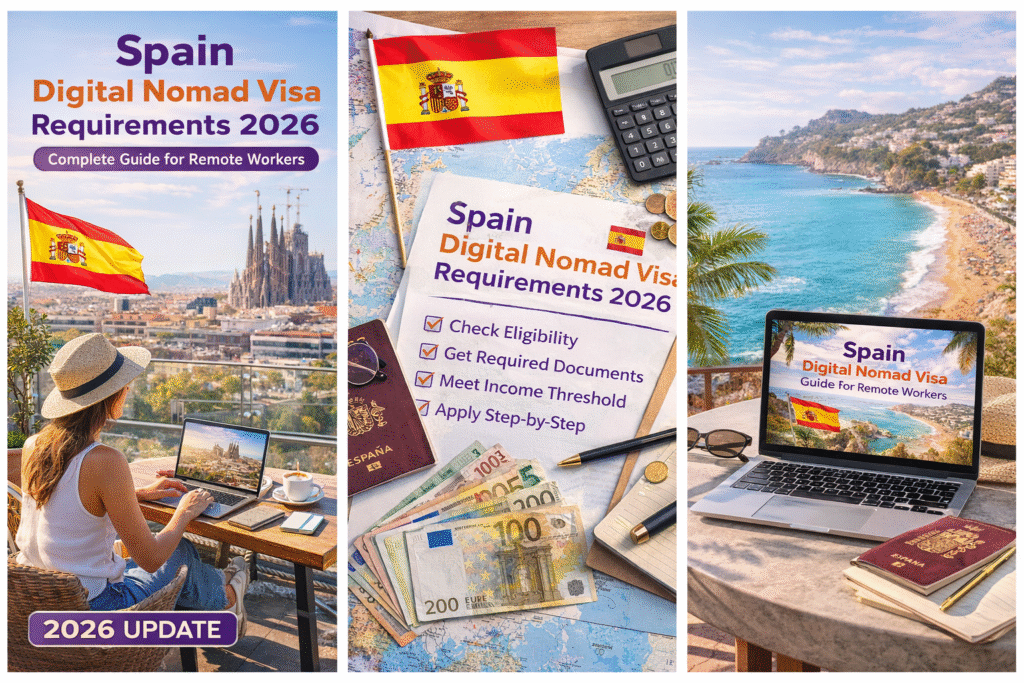

You’ve been working remotely for years. Your laptop goes wherever you do. And now you’re asking the question thousands of freelancers and remote employees are asking: can I actually live and work legally in Spain?
The short answer is yes — and the Spanish digital nomad visa (also known as the nomad visa for Spain) is your legal pathway. This visa is specifically designed for non-EU citizens who want to live and work remotely in Spain. Officially called the International Telework Visa or Visado de Trabajo a Distancia, it was introduced under Spain’s Startup Act in January 2023 for professionals like you: non-EU professionals who work online for companies or clients based outside Spain.
But the Spanish digital nomad visa requirements 2026 have been updated, income thresholds have changed, and the documentation scrutiny has increased. Getting this wrong means rejection — and waiting months to try again.
This guide covers everything you need to know: eligibility, income requirements, documents, the step-by-step application process, tax advantages, and common mistakes that sink applications. Updated with the latest 2026 figures.
What Is the Spain Digital Nomad Visa?
The Spain Digital Nomad Visa — or Visado de Trabajador a Distancia — is a residence authorization that allows non-EU/EEA citizens to live in Spain while working remotely. The nomad visa in Spain is a specific legal residence permit designed for remote workers, enabling them to reside in Spain while maintaining employment abroad. You can be an employee of a foreign company or a self-employed freelancer/contractor.
What makes it unique compared to older options like the Non-Lucrative Visa is that it explicitly allows you to earn income while residing in Spain — as long as that income comes primarily from outside Spain. Specifically, if you are a freelancer, work for Spanish clients is permitted but your Spanish sourced income cannot exceed 20% of your total professional activity.
Applications for the digital nomad visa are reviewed and approved by Spanish immigration authorities, who assess each case and documentation to ensure compliance with immigration policies.
Key Facts at a Glance (2026)
Open to: Non-EU/EEA citizens only
Visa validity: Up to one year (applied from abroad) or up to three years (applied from within Spain)
Renewal: Spain Digital Nomad Visa Residence permit can be renewed for up to three years, with a total legal residence of up to five years
Path to permanent residency: Yes, after five years of continuous legal residence
Family members: Spouse, dependent children, and dependent ascending relatives can join you
Schengen access: Full visa-free access to the Schengen Area
Tax advantage: Special tax regime (Beckham Law) — flat 24% tax rate for up to six years for eligible digital nomads, allowing taxation as non-residents and significant tax relief
Spain Digital Nomad Visa Requirements 2026: Full Eligibility Criteria
Meeting the Spain digital nomad visa requirements in 2026 comes down to three core pillars: your professional profile, your financial situation, and your personal legal standing.
Applicants must demonstrate sufficient income, specifically a minimum monthly income as set by Spanish authorities, typically at least 200% of Spain’s Minimum Interprofessional Salary (SMI), to qualify for the digital nomad visa.
For your professional profile, you will need to show either a university degree, at least three years of relevant work experience, or a relevant professional certificate.
1. Professional Requirements
Spain’s immigration authority wants to see that you are a qualified professional. You must demonstrate one of the following:
A university degree or postgraduate qualification from a recognized institution, OR
A professional certificate demonstrating relevant expertise, OR
At least 3 years of professional experience in your current field
Additionally, if you are an employee, you must prove you have been working for your current employer for a minimum of 3 months before applying. Your employer’s company must also have been in continuous operation for at least one year — you’ll need to provide official documentation (such as a Companies House certificate in the UK or a Secretary of State certificate in the US).
2. Income Requirements (Updated for 2026)
The financial threshold is the most frequently misunderstood part of the Spain digital nomad visa requirements 2026. The minimum monthly income is set at 200% of the Spanish national minimum wage (SMI), also known as Spain’s Minimum Interprofessional Salary.
As of 2026, the annual SMI is €17,094 (14 payments), which sets the bar as follows:
| Applicant | Minimum Monthly Income |
| Main applicant (solo) | €2,849 / month |
| + Spouse or first dependent adult | +€1,068 / month (75% of SMI) |
| + Each additional child | +€356 / month (25% of SMI) |
| Family of 3 (applicant + spouse + 1 child) | €4,273 / month total |
Pro tip: While the official requirement is ~€2,849, immigration experts recommend showing at least €3,000/month in documented income. This buffer protects against currency fluctuations and demonstrates financial stability beyond the bare minimum.
Income can be combined from multiple sources (salary + freelance contracts). However, if you also have Spanish-source income, it must not exceed 20% of your total.
Note: Spain has double taxation treaties with over 90 countries to prevent double taxation on the same income.
3. Health Insurance
You must hold valid private health insurance from a provider authorized in Spain. The policy must provide coverage equivalent to Spain’s public health system (SNS) for you and all accompanying family members, for the entire duration of your stay, with a minimum coverage of €30,000. Private health insurance is mandatory for applicants of the Digital Nomad Visa, as access to Spain’s public health system is generally not granted upon initial entry or visa application. Once you obtain a residence permit and contribute to Spanish social security, you may transition to Spain’s public National Health System (SNS).
4. Criminal Record
A clean criminal record is non-negotiable. You must submit a criminal background check issued recently from every country you have lived in during the past 2 years. Each criminal background check and any other foreign documents must be legalized or apostilled and officially translated into Spanish by a sworn translator.
5. Social Security Coverage
This is the requirement that trips up the most applicants, particularly Americans. You must prove you will remain covered by a social security system while in Spain. The solution varies by nationality:
UK nationals: Obtain an A1 Certificate (form CA3822 for employees or CA3837 for self-employed) from HMRC. Widely accepted.
EU/EEA nationals: Standard S1 form or certificate of coverage from your national authority.
US citizens (employees): The US-Spain Totalization Agreement does not currently cover remote work. Most W2 employees restructure as independent contractors and register as Autónomo in Spain upon arrival.
US citizens (freelancers/1099): Register as Autónomo in Spain when you arrive and begin contributing to Spanish social security.
6. Other Requirements
Must be 18 years of age or older
No prior illegal stay in Spain
No refusal of entry or visa to the Schengen Zone
Must not have been a legal resident in Spain in the past 5 years (for the visa pathway — not applicable for the direct residence permit pathway from within Spain)
How to Apply for the Spain Digital Nomad Visa in 2026: Step by Step
There are two pathways depending on where you are when you apply.
Pathway A: Apply from Abroad (Consulate Route)
This is the standard route for most applicants. You apply at the Spanish consulate in your country of residence or citizenship before traveling to Spain.
- Gather all required documents (see checklist below)
- Book an appointment at your local Spanish consulate. Some applicants may also use a Spanish visa application center, but the local Spanish consulate is the primary authority for processing your application.
- Submit your application with all documents and pay the visa fee (€73.26 per applicant as of 2026)
- Processing times for the Digital Nomad Visa can vary depending on the country and consulate, typically taking between 15 and 45 days for consular applications. If you receive no response, Spain operates a ‘favorable administrative silence’ rule — no news is good news, and the visa is considered approved.
- Once approved, collect your passport with the visa affixed within 1 month
- Travel to Spain and apply for your TIE (Foreigner Identity Card) within the first year
Pathway B: Apply from Within Spain
If you are already legally in Spain — on a tourist/Schengen stay (US, UK, and many other citizens get 90 days visa-free), student visa, or any other valid status — you can apply directly for a 3-year residence authorization without needing the 1-year visa first.
- Confirm you are in Spain legally and your current permission has not expired
- Apply directly at the UGE-CE (Unidad de Grandes Empresas y Colectivos Estratégicos)
- Submit the full document package (same requirements as consulate route)
- Processing time: Approximately 2 weeks
- Receive your 3-year residence authorization directly — no 1-year visa step needed
Important: US passport holders can enter Spain visa-free for up to 90 days within a 180-day Schengen period. This 90-day window is enough time to apply from within Spain and potentially receive your residence authorization before your tourist stay expires.
Document Checklist for the Spain Digital Nomad Visa
This is the most critical section. A single missing or incorrectly apostilled document can result in rejection. All foreign documents must be legalized or apostilled and accompanied by an official Spanish translation to be accepted in Spain. Missing documents or incomplete paperwork are common reasons for visa rejections, so review your checklist carefully. Prepare every item below in advance.
Core Documents (All Applicants)
- National Visa Application Form — completed and signed
- Valid passport — minimum 6 months validity beyond your intended stay, with at least 2 blank pages
- 2 recent passport-sized photos — matte finish, white background
- Proof of residence in your consular district (utility bill, bank statement, etc.)
- Criminal record certificate — from every country you’ve lived in during the past 5 years; apostilled and translated into Spanish
- Private health insurance certificate — valid in Spain, minimum €30,000 coverage
Proof of Remote Work Status (Choose Your Situation)
- If employee: Signed employment contract stating remote work is authorized + company certificate confirming company has been operating for at least 1 year + letter from employer confirming your position and remote work authorization
- If freelancer/self-employed: Active client contracts (minimum 3 months old) + proof of registration as self-employed in your home country + bank statements showing consistent income
Financial Documentation
- Last 3–6 months of bank statements
- Last 3 months of payslips (if employed)
- Tax return or income statement for the previous year
Professional Qualification for the Spain Digital Nomad Visa
- University degree certificate — apostilled and translated into Spanish, OR
- Professional certificate — apostilled and translated into Spanish, OR
- Professional experience letters — minimum 3 years in your field, from previous employers on official letterhead
Social Security Coverage
Certificate of Coverage or A1 form from your home country’s social security authority (varies by nationality — see section above)
For Family Members
- Passport and photos for each member of the family unit, which may include spouses, dependent children, adult children who are financially dependent, and dependent ascendants
- Proof of relationship (marriage certificate, birth certificates) — apostilled and translated
- Criminal records for accompanying adults under Spain Digital Nomad Visa
- Additional income documentation covering the dependent thresholds, including evidence that adult children or other family members are financially dependent on the main applicant
Spain Digital Nomad Visa Tax Benefits: The Beckham Law Explained
One of the most compelling reasons to apply for the Spain visa for freelancers and remote employees in 2026 is the extraordinary tax advantage available to new residents. Digital nomad visa holders who become tax residents in Spain may be required to pay taxes on their worldwide income if they spend more than 183 days in the country or establish their primary residence here.
Under Spain’s Special Expat Tax Regime, known as the Beckham Law, qualifying digital nomads can pay a flat tax rate of 24% on Spanish-sourced income up to €600,000 per year. Foreign-sourced income is generally not taxed under this regime, with certain exceptions. To benefit from the Beckham Law, digital nomads must apply within six months of registering with Spanish Social Security or starting qualifying employment activity.
It is highly recommended that digital nomad visa holders consult with an immigration lawyer or tax expert to fully understand their obligation to pay taxes in Spain, optimize their tax benefits, and ensure compliance with all legal requirements.
The Beckham Law (Régimen de Impatriados)
Under this special regime — officially the ‘Impatriates’ regime, nicknamed after the footballer David Beckham who used it — new Spanish residents who qualify can opt to pay income tax as a non-resident for their first 5 years in Spain.
In practice, this means a flat tax rate of approximately 24% on Spanish-source income up to €600,000. Compare this to Spain’s standard progressive resident tax rates, which reach up to 47% at higher income brackets. For a freelancer earning €5,000/month, the difference over 5 years can amount to tens of thousands of euros.
Who Qualifies?
- You must not have been a Spanish tax resident in the 10 years prior to your arrival
- You must establish tax residency in Spain as a result of your Digital Nomad Visa
- You must apply for the regime separately within 6 months of registering as a Spanish resident
The Beckham Law is not automatic. You must actively apply for it through the Spanish Tax Agency (AEAT) using form 149. Missing the 6-month window means losing the benefit entirely. Our team at Carway Migrate handles this registration as part of our relocation support service.
Why Spain? Key Benefits of the Spain Digital Nomad Visa in 2026
Spain ranked #1 in the Global Citizen Solutions Digital Nomad Report 2025 — the best country in the world for remote workers. Here’s why:
- Cost of living: Significantly lower than Western European peers like Germany, the Netherlands, or Switzerland — especially outside Madrid and Barcelona
- Climate: Over 300 days of sunshine per year in most regions, with a warm climate and sunny days that attract digital nomads year-round
- Rich cultural heritage: Spain is renowned for its diverse art and architecture, shaped by various historical periods
- Diverse landscapes: From beaches to mountains and vibrant cities, Spain’s regions offer a variety of lifestyles and experiences for digital nomads
- Healthcare: Access to Spain’s highly-ranked National Health System once you contribute to social security
- Internet infrastructure: High-speed fiber optic broadband covers even rural areas
- Coworking culture: Thriving digital nomad communities in Barcelona, Madrid, Valencia, Seville, and Malaga
- Path to citizenship: 10 years of legal residence qualifies you for Spanish (and therefore EU) citizenship — or just 2 years if you’re from a Spanish-speaking Latin American country
- Schengen access: Live in Spain and travel freely across 27 European countries, benefiting from Spain’s membership in the European Union (EU) and European Economic Area (EEA), which provides easier mobility, visa exemptions, and access to intra-European travel and residency advantages
Common Mistakes That Get Applications Rejected
Based on current consulate feedback and practitioner experience, these are the most frequent reasons applications for the Spain digital nomad visa 2026 are rejected:
- Income just at the threshold: Showing exactly €2,849 with no buffer is risky. Bank balances with irregular deposits raise flags. Show at least €3,000 consistently.
- Social security certificate issues: Especially for US applicants — if your SSA Certificate of Coverage is rejected, your application fails. Restructuring as a contractor proactively avoids this.
- Missing apostilles or outdated translations: Criminal records and degree certificates must be recent (typically issued within 3–6 months), apostilled, and translated by a sworn translator.
- Incomplete employer documentation: The company stability certificate is often overlooked. Companies House or equivalent records showing 12+ months of operation are required.
- Wrong health insurance: Not all international health insurance policies are accepted. The policy must be from a provider authorized to operate in Spain. Always verify before purchasing.
- Applying at the wrong consulate: You must apply at the consulate with jurisdiction over your district of residence — not just any Spanish consulate.
Ready to Apply? Let Carway Migrate Handle It For You
Navigating Spain’s Digital Nomad Visa requirements on your own can be overwhelming — especially with income thresholds, social security certificates, and apostilled documents that vary by country. Our immigration experts at Carway Migrate have helped hundreds of remote workers and freelancers achieve legal residency in Spain with zero stress.
Contact us today for your consultation and let us guide you through every step — from document preparation to your TIE card.
Frequently Asked Questions: Spain Digital Nomad Visa 2026
Can I apply for the Spain Digital Nomad Visa if I am already in Spain as a tourist?
Yes. If you are legally in Spain on a tourist or Schengen visa-free stay, you can apply directly for the 3-year residence authorization without needing to leave and apply from your home country. US passport holders especially benefit from this route since they get 90 days of visa-free access to Spain.
How long does it take to process the Spain Digital Nomad Visa?
When applied from abroad at a consulate, the legal maximum processing time is 20 working days. In practice, many consulates process applications in 4–8 weeks. Applications submitted from within Spain at the UGE-CE are often processed in approximately 2 weeks. Spain’s ‘favorable administrative silence’ rule means that if you receive no decision within the deadline, your application is automatically approved.
Can I work for a Spanish company on the Spain Digital Nomad Visa?
If you are self-employed or a freelancer, yes — but Spain-sourced income cannot exceed 20% of your total professional income. If you are an employee, you must work exclusively for companies located outside Spain. Working for a Spanish employer as an employee on this visa is not permitted.
Do I need to live in Spain for a minimum number of days per year?
For the initial visa there is no minimum stay requirement. However, to renew your residence permit, you must have lived in Spain for at least 6 months within the preceding 12-month period. Consistently spending less than this risks jeopardizing your renewal and your path to permanent residency.
What is the income requirement for the Spain Digital Nomad Visa in 2026?
As of 2026, the minimum income requirement for the main applicant is €2,849 per month (200% of Spain’s SMI). For a family of two, the total requirement rises to approximately €3,917/month, and for a family of three it is approximately €4,273/month. Immigration specialists recommend showing at least €3,000/month as the sole applicant to provide a comfortable buffer.
What happens after my Digital Nomad Visa expires? Can I renew it?
Your initial visa is valid for 1 year (or 3 years if applied from within Spain). You can then renew your TIE residence card for an additional 2 years, bringing your total authorized stay to 5 years. After 5 years of legal residence, you can apply for long-term EU residency. After 10 years (or 2 years if you are from a Spanish-speaking Latin American country), you can apply for Spanish citizenship.
Can my spouse or partner work in Spain on a family visa under my Digital Nomad Visa?
Yes. Family members who obtain a family visa through your Digital Nomad Visa are permitted to work in Spain — either as employees or as self-employed individuals — without needing a separate work authorization. This is a significant advantage over other visa types.
Final Thoughts: Is the Spain Digital Nomad Visa Worth It in 2026?
If you are a freelancer, remote employee, or independent contractor earning at least €2,849/month and looking for a long-term European base, the Spain Digital Nomad Visa is one of the best residency programs in the world right now. The combination of quality of life, the Beckham Law tax benefit, a clear path to permanent residency and EU citizenship, and Schengen access is simply unmatched, especially when guided by an Immigration attorney Spain.
The process is not simple — documentation requirements are strict, income must be well-documented, and the social security coverage question varies by nationality. But with proper preparation — or the right immigration partner — approval rates are high.
Spain is waiting. The only question is: are you ready?
Ready to Apply? Let Carway Migrate Handle It For You
Navigating Spain’s Digital Nomad Visa requirements on your own can be overwhelming — especially with income thresholds, social security certificates, and apostilled documents that vary by country. Working with an immigration lawyer can help ensure all documentation for the Digital Nomad Visa is complete and properly submitted. Our immigration experts at Carway Migrate have helped hundreds of remote workers and freelancers achieve legal residency in Spain with zero stress. Legal assistance can also help you prepare for potential challenges during the visa application process, including appeals if your application is denied.