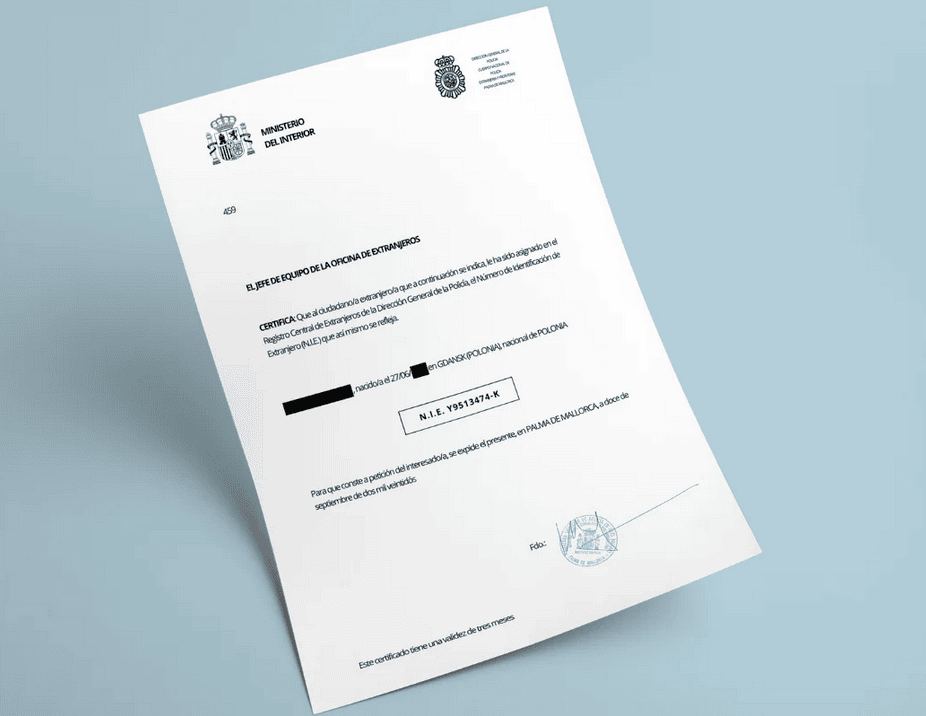
Book Your NIE Spain Appointment Online
Although the NIE number itself is the same format in all cases, there are two distinct situations in which you obtain it, with different forms and different implications.
For Those Living in Spain
Resident NIE
- Issued alongside or after a residency permit (DNV, NLV, work visa, etc.)
- For EU citizens: obtained via form EX-18 and the Green Certificate process
- For non-EU citizens: the NIE is embedded in the TIE card (residence permit)
- Tied to your legal status in Spain
- Valid for the duration of your residence
For Non-Residents
Non-Resident NIE
- For foreigners who need a NIE without living in Spain
- Common for property buyers, investors, or business owners
- Form used: EX-15
- Requires proof of an economic, professional, or social reason
- Can be applied for at a Spanish consulate abroad
Non-EU citizens planning to live in Spain on a long-term visa (Digital Nomad, Non-Lucrative, etc.) will typically obtain their NIE as part of their residency application—the NIE number appears on their TIE card rather than as a separate document.
5. Documents Required for Your NIE Spain Application Spain Application
The exact documents depend on whether you are applying as an EU or non-EU citizen, and whether you are applying in Spain or at a consulate abroad. Below is the standard document set for the most common scenarios.
For EU Citizens Applying in Spain (Green Certificate / EX-18)
Required Documents
✓ Completed Form EX-18 (in Spanish; print two copies)
✓ Valid passport or national ID card (original + photocopy of all pages)
✓ Proof of the reason for needing the NIE (job offer, property purchase agreement, enrollment letter, etc.)
✓ Payment of Tasa 790 (Tax Form 790, Code 012) — fee approximately €12
✓ Two recent passport-sized photos (some police stations request these)
✓ Proof of address in Spain if available (Padrón certificate — some stations require this)
For Non-EU Citizens Applying for a Non-Resident NIE (EX-15)
Required Documents
✓ Completed Form EX-15 (original + one copy), signed and indicating your reason for applying
✓ Valid passport (original + photocopy of biographical data page)
✓ Supporting document proving your reason (property contract, business documentation, etc.)
✓ Completed and paid Form 790, Code 012 — fee approximately €9.84–€12
✓ If applying via a representative: original power of attorney + representative’s ID/passport
⚠️
The Wrong Form Is a Common Mistake
EU citizens use EX-18. Non-EU citizens applying for a non-resident NIE use EX-15. Do not bring the English-language version of either form to your appointment—Spanish authorities only accept the Spanish version. Download the correct form from the Spanish government website and complete it
When it comes to NIE Spain requirements, if you are already in Spain (as a tourist, on a student visa, or as a resident), you apply for your NIE at the Policía Nacional station or Oficina de Extranjería (Foreigners’ Office) in the province where you are living. You cannot go to any police station—it must be one that handles NIE and foreigner registration.
Office) in the province where you are living. You cannot go to any police station—it must be one that handles NIE and foreigner registration.
1
Book Your Appointment (Cita Previa) Online
Go to sede.policia.gob.es (the Spanish National Police appointment portal). Select your province from the dropdown, then choose the appropriate service:
- EU citizens: Select “POLICIA – CERTIFICADO DE REGISTRO DE CIUDADANO DE LA UE”
- Non-EU citizens: Select “POLICIA – ASIGNACIÓN DE NIE”
Enter your passport details, confirm your information, and secure your appointment. Appointments can be scarce in major cities—check frequently, as slots appear and disappear quickly.
2
Pay the Tasa 790 Fee
Download Form 790, Code 012 from the Spanish Tax Agency website. Complete it with your personal details and pay at any Spanish bank branch (or online via some banks). Keep the receipt—this is proof of payment and must be brought to your appointment.
3
Prepare Your Documents
Assemble every document required for your scenario (see Section 5). Make photocopies of everything—the police station will not make copies for you. Bring originals and copies.
4
Attend Your Appointment
Arrive on time. Physical presence is mandatory—you cannot send someone on your behalf unless you have granted a notarised power of attorney. Submit your documen
For NIE Spain purposes, in many cases, EU citizens receive their Green Certificate (containing the NIE) on the same day. Non-EU citizens applying for the non-resident NIE may wait 1–2 weeks, though timelines vary by city. You may receive a receipt at the appointment and collect your NIE certificate later.
-EU citizens applying for the non-resident NIE may wait
1–2 weeks, though timelines vary by city. You may receive a receipt at the appointment and collect your NIE certificate later.
7. Applying from Abroad at a Spanish Consulate
If you are not yet in Spain, you can apply for a non-resident NIE at the Spanish consulate in your country of residence. This route is most common for property buyers who are closing a purchase remotely, or for applicants who want their NIE sorted before they arrive.
The process follows the same document requirements (EX-15 form, passport, justification letter, fee payment), but the appointment is booked through the consulate’s own scheduling system rather than the Spanish police portal. Timelines vary significantly: some consulates proces
In the context of NIE Spain, you can appoint a Spanish lawyer or authorised representative to apply for your NIE in Spain on your behalf. They will need a notarised power of attorney from you, apostilled if issued outside Spain. This is particularly practical for property buyers who want to close quickly without travelling.
ative to apply for your NIE in Spain on your behalf. They will need a notarised power of attorney from you, apostilled if issued outside Spain. This is particularly practical for property buyers who want to close quickly without travelling.
8. NIE Appointments by City: What to Expect
NIE appointment availability varies enormously depending on the city. In high-demand locations (Madrid, Barcelona), appointments can be difficult to secure and may require checking the portal multiple times a day. In smaller cities and towns, appointments are often available within days.
Madrid
High demand. Check portal early morning. Multiple foreigners offices across the city.
Barcelona
Very competitive. Also check Granollers and Cornellà de Llobregat stations.
Valencia
Moderate demand. Typically faster than Madrid/Barcelona.
Seville
Reasonably accessible. Appointments usually within 1–3 weeks.
Málaga
High expat population. Plan ahead; significant demand from the Costa del Sol area.
Alicante
Popular among British and German expats. Check multiple stations in the province.
Bilbao
Lower demand. Usually faster appointment availability.
Smaller cities
Often same-week appointments. Consider registering in a smaller province if flexibility allows.
9. NIE vs. TIE: Understanding the Difference
This distinction confuses many newcomers to Spain. Here is the clearest possible explanation:
- NIE (Número de Identificación de Extranjero) is a number—your unique identifier in Spain’s system. It never changes, never expires, and follows you for life regardless of your visa status.
- TIE (Tarjeta de Identidad de Extranjero) is a physical card—your residence permit card, issued to non-EU citizens who obtain residency in Spain. It contains your NIE number printed on it, along with your biometric data and the validity p
When it comes to NIE Spain requirements, when you hear someone say “I need to renew my NIE,” what they actually mean is that they need to renew their TIE card (residence permit). The NIE itself never requires renewal.
ration certificate that also contains your NIE and confirms your right to reside in Spain.
When you hear someone say “I need to renew my NIE,” what they actually mean is that they need to renew their TIE card (residence permit). The NIE itself never requires renewal.
10. Expert Tips to Avoid Delays
- Print the Spanish-language form only. The English version is for reference. Never bring it to your appointment.
- Bring more copies than you think you’ll need. Officials will not make photocopies for you. Bring three copies of every document to be safe.
- Pay the Tasa 790 before the appointment. Do not try to pay at the police station—it must be paid at a bank branch in advance.
- Have a justification letter ready. If your reason for needing the NIE is not immediately obvious from your documents, prepare a brief letter (in Spanish) explaining why you need it.
- Appointments in Madrid and Barcelona are scarce. Set calendar reminders to check the portal at midnight and early morning, when new slots often appear.
- Consider a third-party service or lawyer. Several reputable immigration agencies and law firms (including Carway Migrate) can book and attend NIE appointments on your behalf, which is especially useful if your Spanish is limited or if appointment slots are consistently unavailable.
- Keep your NIE certificate safe. If you lose the physical certificate, you will need a new appointment to request a duplicate—the number remains the same, but the process takes time.
Need Help Getting Your NIE?
Our lawyers attend NIE appointments on behalf of clients across Spain, handling everything from booking to document submission—so you don’t have to queue or navigate the system alone.
Speak to Our Team
Frequently Asked Questions
How much does a NIE cost in Spain?
The official government fee for the NIE (paid via Form 790, Code 012) is approximately €9.84 to €12 depending on the current rate. There is no other official fee. Any additional costs are for third-party services (lawyers, agencies) or sworn translations if documents need to be prepared.
Can I use my NIE immediately after receiving it?
Yes. Once you receive your NIE certificate or TIE card, the number is active and can be used immediately for any administrative purpose—opening a bank account, signing contracts, paying taxes, and so on.
Does my NIE expire?
The NIE number itself never expires. However, the physical documents that contain or display the NIE (the TIE card for non-EU residents, or the Green Certificate for EU citizens) have validity periods tied to your residence permit. When you renew your residence permit, you also renew your physical card—but your NIE number stays the same.
If I am getting a Digital Nomad Visa, do I still need to apply for a NIE separately?
Generally, no. When your Digital Nomad Visa is granted and you receive your TIE card, your NIE is embedded in that card. You do not need to apply for it separately. The NIE application is effectively built into the residency permit process for non-EU applicants. For EU citizens, the process is slightly different—see Section 4 of this guide.
What if no NIE appointments are available in my city?
Appointment scarcity is real, especially in Madrid and Barcelona. Options include: checking the portal multiple times daily (slots open and close quickly), trying adjacent towns or provinces, using a Spanish lawyer or agency to check continuously on your behalf, or if you have an urgent property purchase, some notaries can issue a temporary NIE for that specific transaction.
Can I work in Spain with just a NIE?
No. The NIE identifies you for tax and administrative purposes but does not authorise you to work. To work legally in Spain, you also need an appropriate work or residence permit (such as the Digital Nomad Visa, a work visa, or EU citizen registration). However, you will need a NIE as part of any work permit application or when your employer registers you with Social Security.
I already have a NIE from a previous stay in Spain. Do I need a new one?
No. Your NIE is assigned once and for life. If you lived in Spain previously and were issued a NIE, that same number is yours permanently—even if years have passed. You may need to update your physical documents (TIE card) if your residency status has changed, but the underlying NIE number does not change.