


Let’s start with the question nobody wants to ask out loud: is hiring a Spanish immigration lawyer actually worth it, or is it one of those things people do out of anxiety and end up not needing?
It’s a fair question. And the honest answer is — it depends on your situation. Some people navigate the Spanish immigration process just fine on their own. Others lose months to a rejected application because of a document that was apostilled in the wrong format, or a health insurance policy that wasn’t accepted by that particular consulate. The difference between those two outcomes usually comes down to preparation and knowledge — not luck.
This guide will help you figure out where you stand. We’ll cover what an immigration lawyer in Spain actually does day to day, the situations where professional help genuinely pays for itself, and what to look for if you decide you want someone in your corner. We’ll also tell you a bit about how we work at Carway Migrate — not to sell you anything, but because seeing a real example makes all of this more concrete.
What does a Spain immigration lawyer actually do?
The term ‘immigration lawyer’ can mean different things in different countries. In Spain, what you’re typically looking for is a specialist in extranjería — the body of Spanish law that governs foreigners’ rights, visas, permits, and nationality. Some of these specialists are registered abogados (lawyers), others are gestores or advisors with deep administrative expertise. For most visa applications, either can serve you well. For appeals, court proceedings, or complex nationality cases, you’ll want a fully qualified lawyer.
💡 Pro tip
You can verify any Spanish lawyer’s credentials directly on the Bar Association website for their city. For Madrid lawyers, check the official directory at the Ilustre Colegio de Abogados de Madrid — search by name and you’ll know in seconds whether they’re properly registered and in good standing.
In practical terms, here is what working with a good immigration specialist looks like. They sit down with you — virtually or in person — and understand your specific situation before recommending anything. Then they map out exactly what documentation you need, in what format, translated by whom, apostilled by which authority, and submitted to which office. They deal with the back-and-forth with Spanish authorities so you don’t have to learn a new bureaucratic language from scratch. And if something goes wrong, they know how to respond.
The part people underestimate is the document review. Spanish consulates and immigration offices are very literal in their requirements. A supporting letter from your employer that says ‘John works remotely’ will get rejected if it doesn’t include specific language about the authorisation to work from Spain. A criminal record check that’s three months and one day old will be returned. These aren’t edge cases — they’re the most common reasons applications fail.
⚠️ Good to know
The part people underestimate is the document review. Spanish consulates are very literal — one missing phrase in a supporting letter can set you back by two months.
When does it actually make sense to hire one?
If your situation is straightforward — you have a stable, well-documented income, a clear employment relationship, and you’re applying from a country with a functioning consulate and simple apostille process — you might be fine managing your own application with careful research. Some people do.
But there are specific scenarios where the case for professional help becomes much stronger. If you’re a US citizen applying for the Digital Nomad Visa, the social security coverage requirement alone is a known headache that has derailed plenty of applications — the US-Spain Totalization Agreement doesn’t cover remote work, and what you need to do instead isn’t obvious. If you’re applying from a Latin American country where apostille timelines are unpredictable, or where certain documents require additional legalisation steps, a specialist who already knows those nuances saves you from discovering them the hard way.
If you’ve already been rejected once, professional help isn’t optional — it’s essential. Understanding exactly why an application was refused, whether an appeal is viable, and how to strengthen the resubmission requires specific legal knowledge. And if you’re pursuing Spanish citizenship, which involves a registry process that can take years and has very specific evidentiary requirements, having an experienced specialist is simply the sensible choice.
💬 Real case
“One client came to us after a self-managed rejection. The reason? Her employer’s letter confirmed remote work — but didn’t explicitly authorise her to work from Spanish territory.”
One sentence. Two months lost.
A quick look at Spanish immigration law in 2026
You don’t need to be an expert in Spanish immigration law to navigate it — that’s what specialists are for. But it helps to understand the broad landscape so you can have an informed conversation with whoever you work with.
The framework that gets the most attention right now is the Startup Act (Ley de Startups), which brought the Digital Nomad Visa into existence in January 2023. It’s still fully active, and the income threshold has been updated to reflect Spain’s new minimum wage — you need to show around EUR 2,849 per month as the main applicant in 2026. The scrutiny on applications has increased compared to the early days, particularly around social security documentation.
Beyond the nomad visa, the most common pathways are the Non-Lucrative Visa for people with passive income or savings, employer-sponsored work permits for those relocating for a specific job, and family reunification for people joining a relative already resident in Spain. Each has its own logic, its own documentation, and its own processing timeline.
One thing that doesn’t get enough attention in English-language guides: if you’re from a Spanish-speaking Latin American country, you can apply for Spanish citizenship after just two years of legal residence — compared to ten years for most other nationalities. That changes the strategic calculation considerably for anyone from the region.
How to choose the right immigration specialist
The market for immigration help in Spain has grown a lot in the past few years, which is mostly a good thing — more competition means more options and generally better service. But it also means there are firms that overpromise, underdeliver, or simply don’t have the depth of experience their marketing suggests.
The first thing to look for is genuine specialisation. Immigration law in Spain moves quickly — rules change, consulate practices vary, processing times shift. You want someone who is immersed in this field, not a generalist who handles immigration alongside property law and family disputes. Ask them directly: what percentage of your caseload is immigration? How many cases like mine have you handled in the past year?
Meet the team behind Carway Migrate
Transparency about fees matters more than people realise. A good immigration lawyer in Spain will give you a clear breakdown of what’s included before you commit to anything — not a vague estimate that grows as the process unfolds. If they’re evasive about pricing, that tells you something.
And then there’s communication. If you’re applying from outside Spain — which most people are — you need a team that responds promptly, explains things clearly in your language, and keeps you informed without you having to chase them. This sounds obvious, but it’s the thing clients most often complain about when things go wrong with other firms.
How we work at Carway Migrate
We built Carway Migrate — /es— around one simple idea: immigration should feel manageable, not overwhelming. That sounds like marketing, so let us be specific about what it means in practice.
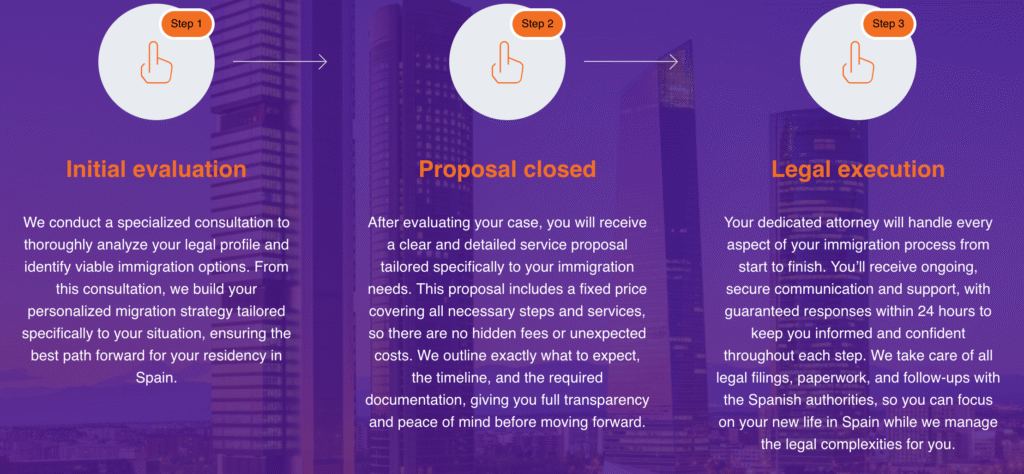
Every client starts with a proper consultation. Not a sales call — an actual conversation where we understand your situation, your goals, and your timeline before we recommend anything. A lot of people come to us having already decided on a particular visa type, and sometimes we confirm that’s the right choice. Sometimes we suggest a different route that they hadn’t considered, because their situation actually fits it better.
Once we’re aligned on the pathway, we give you a precise checklist — not a vague ‘gather your documents’ list, but a specific document-by-document breakdown with format requirements, translation specifications, and deadlines. We review everything before it goes anywhere near a submission. We communicate with the relevant Spanish authorities on your behalf and update you at every significant milestone.
We operate fully remotely, which means we work with clients in Buenos Aires, New York, Lagos, and everywhere in between. The distance doesn’t change the quality of the work — if anything, it’s made us sharper about communication and documentation, because we can’t rely on a face-to-face meeting to fill in the gaps.
A lot of clients tell us they appreciated one thing above everything else: they always knew what was happening and what came next. That’s not an accident — it’s how we’re built.
Work with a team that has been through this before
At Carway Migrate we handle the whole process — from working out which visa fits your situation to the moment you hold your TIE card. No jargon, no surprises, no chasing us for updates. Just a clear path forward.
What does it cost to hire an Immigration Lawyer in Spain?
This varies quite a bit depending on the complexity of your case and what level of support you need. As a rough market guide:
| Service | Typical range |
|---|---|
| Initial consultation | EUR 50 – 150 |
| Document review only | EUR 100 – 300 |
| Digital Nomad Visa — full management | EUR 600 – 1,500 |
| Non-Lucrative Visa — full service | EUR 800 – 1,800 |
| Spanish citizenship application | EUR 1,000 – 3,000 |
| TIE renewal | EUR 200 – 500 |
| Appeal after rejection | EUR 500 – 2,000+ |
| ⚠ These are market averages, not quotes. At Carway Migrate you get an itemised breakdown after your consultation — before you commit to anything. | |
40-minute session · Expert advice tailored to your case
The questions people ask us most
-
Is it legally required to use an Immigration Lawyer in Spain for a visa?
No. Most applications can be submitted without legal representation. Whether it’s worth it depends on your specific situation — but the cost of a rejected application, in both time and money, is almost always higher than the cost of getting professional help upfront.
-
Can a lawyer help if my application has already been rejected?
Yes, and this is where it really matters. A specialist will analyse the exact grounds for refusal, advise on whether an appeal (recurso de reposición) makes sense, and prepare a stronger resubmission. There are tight deadlines — usually one month from notification — so don’t wait if you’ve received a rejection.
-
Do I need to be in Spain to work with an Immigration Lawyer in Spain?
Not at all. The whole process can be managed remotely, and most reputable firms — including Carway Migrate — work this way by default. You handle everything digitally, communicate by video call or message, and your specialist manages all submissions on your behalf.
-
Does it matter whether my lawyer is based in Madrid or Barcelona?
Less than you might think. Most applications are processed digitally or through centralised bodies like the UGE-CE. What matters more than geography is experience with the specific consulate or administrative office handling your case — practices vary slightly between jurisdictions, and a good specialist will know the relevant nuances.
-
How long does the process take?
The Digital Nomad Visa resolves in up to 20 working days from a consulate — and if there’s no response by then, Spain’s favourable silence rule means it’s approved. Permits processed from within Spain at the UGE-CE typically take two to four weeks. Work permits and family reunification can take one to three months. Citizenship applications are in a different category — typically one to three years, depending on the registry.
-
What’s the difference between a lawyer and an immigration consultant?
A qualified abogado is licensed to provide formal legal advice and represent clients in court. A consultant or gestor can handle administrative filings but cannot provide legal opinions or appear in legal proceedings. For straightforward applications, either can work well. For appeals, complex situations, or citizenship applications, a qualified lawyer is the safer choice.
One last thought
Moving to Spain is a big decision. The paperwork is just the practical layer on top of something much more significant — a new chapter, a different life, sometimes a completely fresh start. The people we work with at Carway Migrate aren’t looking for a form-filling service. They want to feel like someone genuinely understands their situation and knows how to get them across the finish line.
If that sounds like what you’re looking for, a 40-minute call usually answers most of the questions people have been sitting on for weeks. There’s no pressure, no commitment — just clarity on what your options are and what the process actually looks like for someone in your situation.
40-minute session · Expert advice tailored to your case