

Both visas offer a legal path to living in Spain. Both require private health insurance, a clean criminal record, and proof of financial means, including a minimum monthly income that is at least double the Spanish national minimum wage (currently €1,184 net EUR). But the choice between them—based on how you earn, how you work, and how you’ll be taxed—can have consequences that play out over years. Spain Non-Lucrative Visa vs Digital Nomad Visa: this guide gives you a clear, practical way to decide.
Spain is a popular destination for digital nomads thanks to its relatively affordable cost of living compared to other Western European countries, its rich cultural heritage with diverse art and architecture, and a vibrant digital nomad community, especially in cities like Madrid and Barcelona. The Spanish Digital Nomad Visa is also relatively easy to obtain compared to other countries, with a minimum monthly income requirement set at double the Spanish national minimum wage, making it accessible for many remote workers.
Contents
- The Two Visas at a Glance
- The Fundamental Difference: Work vs. Passive Income
- Head-to-Head Comparison Table
- Income Requirements: How Much Do You Need?
- Non-Lucrative Visa Spain vs Digital Nomad Visa Spain: Non-Lucrative Visa Spain vs Digital Nomad Visa Spain: Tax Implications
Non-Lucrative Visa Spain
Live in Spain without working. Designed for retirees, financially independent individuals, and those with substantial passive income.
Digital Nomad Visa Spain
Live and work remotely in Spain. Designed for remote employees and freelancers earning income from non-Spanish employers and clients.
The Non-Lucrative Visa Spain (NLV) has existed for decades and is one of the most widely used residency routes for non-EU nationals. The Digital Nomad Visa (DNV) is newer, introduced in January 2023 under Spain’s Startup Act as a response to the global remote work shift. The NLV requires you to have money but not earn it while in Spain. The DNV requires you to be actively earning—but only from foreign sources.
2. The Fundamental Difference: Work vs. Passive Income
The clearest way to separate these two visas is by asking one question: Will you be working while in Spain?
The Non-Lucrative Visa Spain is a residency-only permit. You are allowed to live in Spain, but you are strictly prohibited from performing any professional activity—including remote work for a foreign employer or client. Your income must be entirely passive: pensions, investment returns, rental income from foreign properties, dividends, savings drawdown. If you work while on an NLV, even for a company in another country that you never visit, you are in breach of your visa conditions. The consequences include visa revocation and potential Schengen-area bans.
When it comes to Non-Lucrative Visa Spain requirements, the Digital Nomad Visa Spain is fundamentally different: it explicitly authorises you to work remotely for foreign companies or clients while residing in Spain. You are permitted to earn income from active professional work—as a salaried employee of a foreign company, or as a self-employed freelancer—as long as no more than 20% of your total income comes from Spanish sources.
Working Remotely on an NLV Is Visa Fraud Many people lived the “unofficial” digital nomad life in Spain on a Non-Lucrative Visa Spain before the DNV existed, quietly working remotely and hoping no one noticed. This was always illegal. Now that the DNV exists as the correct legal route, Spanish authorities have less tolerance for this grey-zone approach. If you work remotely, the Digital Nomad Visa Spain is the only safe and legally compliant option.
3. Head-to-Head Comparison: Spain Non-Lucrative Visa vs Digital Nomad Visa
| Non-Lucrative Visa Spain | Digital Nomad Visa Spain | |
|---|---|---|
| Can you work remotely? | NO — strictly prohibited | YES — for foreign employers/clients |
| Income source required | Passive only: pensions, investments, savings, rental income | Active remote income from non-Spanish employers or clients |
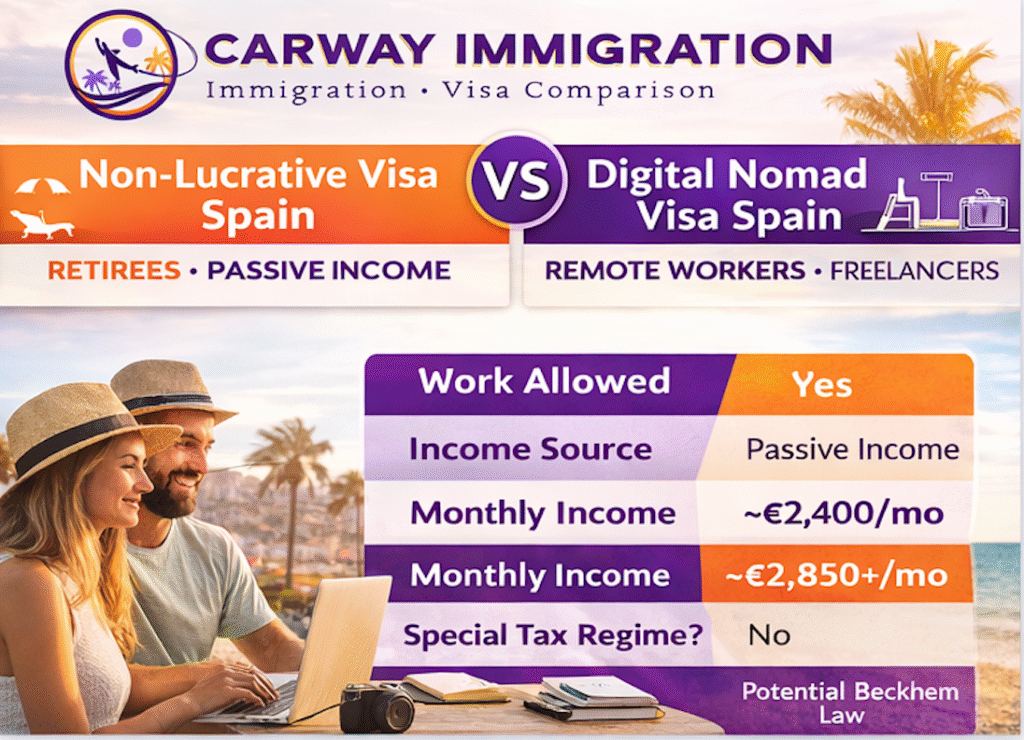
| Minimum income (single) | ~€2,400/month (400% IPREM) | ~€2,762/month (200% SMI) |
| Initial validity | 1 year (from abroad) | 1 year consulate; 3 years from within Spain |
| Renewal | 2-year renewals (up to 5 years total) | 2-year renewals (up to 5 years total) |
| Where to apply | Consulate only | Consulate abroad OR from within Spain |
| Processing time | Up to 3 months | 20 working days statutory (3–8 weeks in practice) |
| Tax regime (183+ days/year) | Standard IRPF: 19–47% on worldwide income | May qualify for Beckham Law: 24% flat rate |
| Beckham Law eligible? | NO | Conditional — employees most likely; freelancers more complex |
| Spanish work permitted? | NO | Up to 20% from Spanish clients |
| Professional qualification? | NO | YES — degree or 3+ years’ experience |
| Employment history? | NO | YES — 3 months with current employer |
| Social Security | Private health insurance only | Home country SS or voluntary Spanish SS |
| Path to permanent residency? | YES — after 5 years | YES — after 5 years |
| Path to Spanish citizenship? | YES — after 10 years | YES — same rules as NLV |
4. Income Requirements: How Much Do You Need?
Both visas require you to prove sufficient financial means and provide the required documents to demonstrate this, such as employment contracts, payslips, or bank statements. The amounts and the type of income accepted differ significantly.
Non-Lucrative Visa €2,400 per month (400% IPREM 2025/2026)
Income must be passive (pensions, dividends, rental income, savings returns, investment income)
- Add ~€600/month for each additional family member
- Bank statements showing consistent income over 6–12 months are typically required
- Most consulates want bank stamps and confirmation letters—not just printed statements
Digital Nomad Visa Spain
Applicants must demonstrate a minimum monthly income equivalent to 200% of Spain’s Minimum Interprofessional Salary (SMI), which as of 2026 is approximately €2,850+ per month. If applying with dependents, the income requirement increases by 75% of the SMI for the first dependent and 25% for each additional dependent. Income may be demonstrated through employment contracts, payslips, or bank statements. The income thresholds for the Digital Nomad Visa are tied directly to Spain’s SMI and may adjust annually.
- Income must be from active remote work for non-Spanish entities
- Add ~€1,036/month for a spouse; ~€350/month per additional dependent
- Income can be combined from multiple foreign clients or employers
- No more than 20% of total income can come from Spanish sources
5. Tax Implications: The Biggest Difference Nobody Talks About Enough
If you spend more than 183 days in Spain in a calendar year, you become a Spanish tax resident—and this is where the NLV and DNV diverge dramatically in their financial consequences.
Non-Lucrative Visa
Standard Spanish IRPF
- Taxed on worldwide income at progressive rates
- Rates: 19% to 47% (higher in some autonomous communities)
- Must declare global assets above €50,000 via Modelo 720
- Wealth Tax may apply on global assets (depending on region)
- Access to standard deductions, family credits, mortgage relief
- No access to the Beckham Law
Digital Nomad Visa Spain
Potential Beckham Law Eligibility
- 24% flat rate on Spanish-sourced income (up to €600,000)
- Foreign income largely exempt from Spanish tax
- Wealth Tax only on assets in Spain
- No obligation to declare foreign assets under Modelo 720
- Lasts 6 years; must apply within 6 months of arrival
- Not automatic—employees qualify more easily than freelancers
For a professional earning €100,000 per year under the DNV with Beckham Law access, the tax bill is €24,000. Under the NLV’s standard IRPF, the same income would generate roughly €35,000–€42,000 in tax depending on the region and available deductions. Over six years, this difference can amount to tens of thousands of euros.
Not All DNV Holders Qualify for Beckham Law
Holding a Digital Nomad Visa Spain does not automatically entitle you to the Beckham Law. The most reliable path is as an employee of a foreign company on a Spanish-registered employment contract. Freelancers serving multiple clients face a more complex assessment. Additionally, you must not have been a Spanish tax resident in the five years before your move, and you must apply within six months of arriving. See our dedicated Beckham Law guide for full eligibility details.
For NLV holders, it’s worth noting that pension income may be treated differently depending on bilateral tax treaties between Spain and your home country. For example, certain government pensions from the US or UK may be taxed only in the country of origin under applicable tax treaties—reducing the effective Spanish tax burden. Always consult a specialist for your specific situation.
6. Application Process: Where, When, and How
Non-Lucrative Visa Application
The NLV must be applied for from your country of residence, through a Spanish consulate. You cannot apply for an NLV while already in Spain (for example, while on a tourist visa). This is a firm rule with no exceptions. Application processing times vary widely by consulate—from 4 weeks to 3 months—so plan significantly in advance of your intended move date.
Once approved, you enter Spain on a one-year visa. Within the first 30 days of arrival, you must apply for your TIE card (residence permit card) at the local Oficina de Extranjería or police station.
Digital Nomad Visa Application
The DNV offers more flexibility. You can apply either:
- From abroad through a Spanish consulate — you receive an initial 1-year visa
- From within Spain (on a tourist visa, within your 90-day Schengen allowance) — you receive an initial 3-year residence authorisation directly, which is a meaningful advantage
When applying from within Spain, you submit your application to the Big Units companies, which handles all Digital Nomad Visa and Startup Act residency applications nationally. The statutory processing time is 20 working days, though in practice timelines range from 3 to 8 weeks. For a deep dive into the DNV application process, document requirements, and income proof, see our complete Digital Nomad Visa guide.
Ready to start your Spain visa application?
Carway Immigration has handled hundreds of successful visa cases. Let our immigration lawyers guide yours.
Schedule My Consultation →7. Family Members and Dependents
Both visas allow you to bring family members to Spain. The conditions differ slightly.
NLV family members: You must demonstrate that you have sufficient passive income to support your spouse and any dependent children. The additional income required is typically €600/month per dependent family member. Family members apply for their own NLV at the same time, and the applications are linked.
DNV family members: The income thresholds are higher. Typically, you need approximately €1,036/month above the base requirement for a spouse, and €350/month per additional depIn the context of Non-Lucrative Visa Spain, in both cases, family members who are included in your application receive the same rights of residence as you—including the right to work in Spain in the DNV case (since your family members’ permits often carry work authorisation in their own right). Confirm this with your immigration lawyer, as rules can vary. rs’ permits often carry work authorisation in their own right). Confirm this with your immigration lawyer, as rules can vary.
8. Path to Permanent Residency and Citizenship
Both the NLV and DNV count equally toward permanent residency and Spanish citizenship. This is an important point that sometimes gets overlooked: there is no “faster” route to long-term status based on visa type.
- Permanent residency (residencia de larga duración) requires 5 continuous years of legal residence. Both NLV and DNV years count toward this total.
- Spanish citizenship normally requires 10 years of continuous legal residence. Citizens of Latin American countries, the Philippines, Andorra, Equatorial Guinea, Portugal, and individuals of Sephardic Jewish heritage benefit from a reduced 2-year pathway—which applies equally regardless of visa type.
Both Visas Count Equally Toward Residency
Whether you spend five years on an NLV or five years on a DNV, the clock runs the same way. If you switch visa types during your stay—which is possible—the years continue to accumulate as long as your residence remained legal throughout.
9. Spain Non-Lucrative Visa vs Digital Nomad Visa: Switching Between Visas
Life changes, and so do circumstances. It is possible to switch between these visa types while in Spain, though the process requires careful planning.
NLV → DNV: If you start on an NLV and later want to work remotely, you will need to apply for a change of status to the Digital Nomad Visa. You must meet all DNV eligibility criteria at that time, including income requirements and professional qualifications. This is a full new application, not a simple amendment.
DNV → NLV: Less common, but if you stop working and want to transition to a passive income life in Spain, you can switch to the NLV at renewal time, provided you meet the NLV’s passive income requirements.
Years spent legally resident in Spain count toward your 5-year permanent residency threshold regardless of which visa type they were spent on, as long as your residence was continuous and legal throughout.
10. Spain Non-Lucrative Visa vs Digital Nomad Visa: Who Each Visa Is Really For
🏖️ The Non-Lucrative Visa is right for you if…
- You are retired or planning early retirement
- You live off a pension, dividends, rental income, or investment returns
- You have no intention of working—at all, for anyone
- You value a simpler application with fewer professional documentation requirements
- You prefer to apply from your home country before moving
- Your income is consistent and fully passive with no active professional element
- You want a “break” year and may return to work later (but not while on the NLV)
💻 The Digital Nomad Visa is right for you if…
- You work remotely for a foreign employer (employee or contractor)
- You are a freelancer with international clients
- You want to legally work while living in Spain without any ambiguity
- You earn active income and can document your employment history
- You hold a university degree or have 3+ years’ professional experience
- You might qualify for the Beckham Law and want the tax benefit
- You prefer the option to apply from within Spain for a 3-year initial permit
- Your income may partly come from Spanish clients (up to 20%)
11. The Decision Framework: 5 Questions to Find Your Answer
Still not sure? Walk through these five questions:
Will you be doing any professional work while in Spain?
No → NLV candidate If you will not work at all (including remotely), the NLV is your path.
Yes → Digital Nomad Visa If you will work remotely for any employer or client, you need the DNV. The NLV is not an option.
Is your income entirely passive?
Yes → Continue NLV path Pensions, dividends, interest, rental income: all qualify for the NLV’s income requirement.
No → Digital Nomad Visa If any part of your income is earned through active professional work, only the DNV will work.
Do you have a university degree or 3+ years of professional experience?
No → NLV may be simpler The NLV has no professional qualification requirement. If your income is passive and you’re not working, the NLV is more straightforward.
Yes → DNV fully accessible You meet the professional qualification requirement for the DNV. Combined with remote income, you are a strong DNV candidate.
Are you currently in Spain, or will you be applying from your home country?
From home country → Both options available Both the NLV and DNV can be applied for from abroad at a Spanish consulate.
Already in Spain → Only DNV possible The NLV cannot be applied for from within Spain. If you’re already here, the DNV is your only long-term option.
Is tax optimisation a priority for you?
Less important → NLV may suffice For retirees living off pensions (especially those covered by bilateral tax treaties), the tax position under the NLV can still be favourable.
Very important → DNV + Beckham Law If you are a high earner and want to minimise Spanish income tax, the DNV with Beckham Law eligibility is a potentially powerful combination.
The Most Common Misconception Before the DNV existed, many people used the NLV and worked quietly. That grey area no longer exists in quite the same way. If you are earning active income remotely, the DNV is the legally correct route—and in most cases the financially superior one too. The choice, for active remote workers, is not really a choice at all.
Not Sure Which Visa Fits Your Situation?
Our immigration lawyers assess your income structure, employment situation, and long-term plans to recommend the right visa—and handle the entire application from document preparation to submission.
Get a Free Assessment
Spain Non-Lucrative Visa vs Digital Nomad Visa: Frequently Asked Questions
Can I switch from an NLV to a DNV if I start working remotely? Yes, but you need to make a formal application for a change of residency status (or apply for a new DNV). You cannot simply start working while on an NLV without changing your permit first. If you begin working before the status change is approved, you are in breach of your NLV conditions. Plan this transition carefully with legal advice and ideally initiate the DNV application before you begin working.
My income is a mix of dividends and part-time freelance work. Which visa is right for me? If any part of your income comes from active professional work—even occasional freelance income—the Non-Lucrative Visa is not a legal option. You would need the Digital Nomad Visa. If the freelance work is occasional and you plan to wind it down, it might be worth timing your visa application to a period when you can demonstrate fully passive income. Discuss your specific situation with an immigration lawyer before applying.
If I apply for the NLV and later apply for the DNV, do my years of NLV residency count? Yes. Both the NLV and DNV are legal residency statuses in Spain. As long as your residency has been continuous and legal throughout, years under both visas count toward the 5-year permanent residency threshold and the 10-year (or 2-year) citizenship pathway.
The NLV income threshold is lower than the DNV. Could I qualify for the NLV on less income and work anyway? This is not advisable and constitutes visa fraud. The NLV explicitly prohibits any professional activity. Working while on an NLV—even if the work is low-key or for a foreign company—violates your visa terms and could result in revocation of your residency, fines, and a Schengen entry ban. The DNV was created precisely to give remote workers a legal framework. Use it.
My spouse works and I don’t. Can they get a DNV while I get an NLV? Potentially yes, though this would be an unusual arrangement requiring careful legal coordination. More commonly, the working spouse applies for the DNV and includes the non-working spouse as a dependent family member under the same DNV application. This is simpler and keeps both permits aligned. If both partners have very different income situations, consult an immigration lawyer to find the most practical approach.
Is the Digital Nomad Visa better overall? For remote workers with active income, yes—the DNV is more flexible, legally clearer, offers potential Beckham Law access, can be applied for from within Spain, and results in a longer initial permit if applied from Spain. For retirees or financially independent individuals who will genuinely not work, the NLV has simpler professional documentation requirements and is often more appropriate. The “better” visa is entirely defined by your personal situation.
Not sure which visa applies to your situation?
Book a consultation with CarWay and get a clear answer in 40 minutes.
Book Your Consultation →Official Sources & Further Reading
- Ministry of Inclusion – Non-Lucrative Visa
- Ministry of Inclusion – Digital Nomad Visa
- Spain Startup Act 2022 – Official Text
- Spanish National Police – Residence Permits
- Agencia Tributaria – Beckham Law Tax Regime