
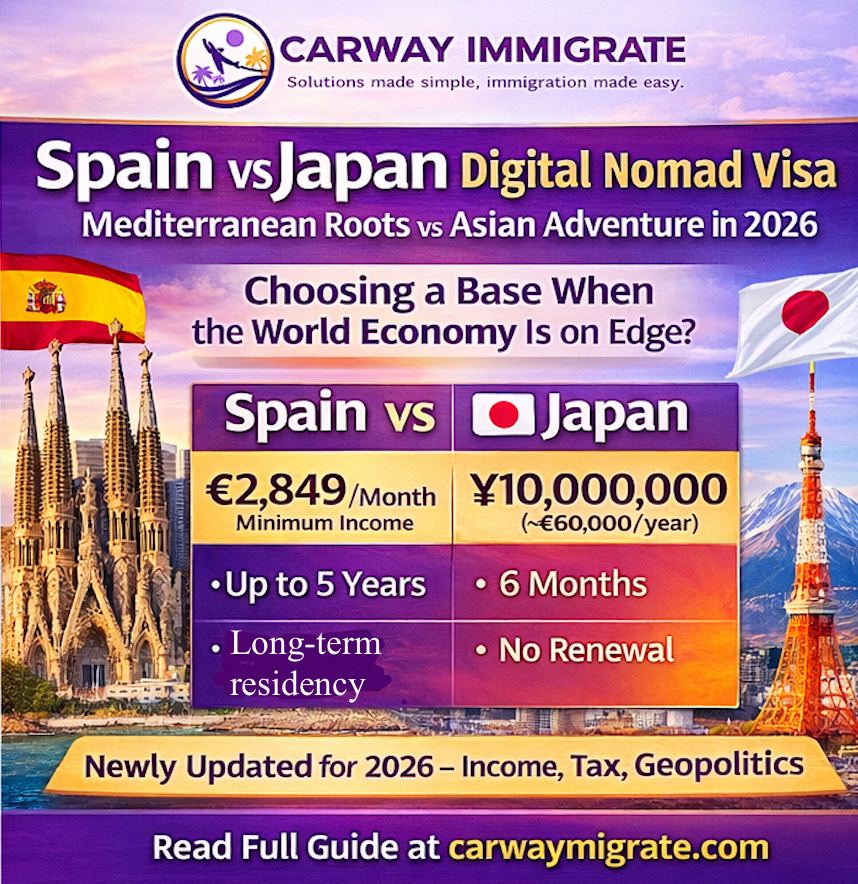

In 2026, digital nomads face new challenges and opportunities as global events reshape the landscape for remote work. This guide is for remote professionals weighing Spain vs Japan digital nomad visas, offering a detailed comparison of requirements, lifestyle, and the impact of world events on your decision. This guide compares the Spain vs Japan digital nomad visa options for 2026, focusing on income thresholds, tax regimes, and how global events may affect your choice.
Spain vs Japan Digital Nomad Visa: Introduction to Digital Nomad Visas
The global shift toward remote work has sparked a revolution in how—and where—we live and earn. As more professionals embrace the digital nomad lifestyle, countries around the world are racing to attract remote workers with dedicated digital nomad visa programs. These nomad visas are designed to make it easier than ever for digital nomads, freelancers, and remote employees to work remotely from a foreign country, often for up to one year or even two years at a time.
A digital nomad visa is a temporary residence permit that allows remote workers to legally live and work in a new country without the need to become a local employee or set up a local company. Typically need to prove a stable monthly income or annual income from remote employment, freelance contracts, or their own company registered abroad. These requirements are designed to ensure that digital nomads can support themselves without relying on local jobs or public services.
One of the biggest draws of digital nomad visas is the potential for tax benefits. Many countries offer tax breaks or exemptions from local income tax for digital nomads, especially if their stay is limited to less than 183 days per year. This can make a digital nomad visa an attractive option for remote workers seeking to optimize their tax situation while enjoying life in a new destination. Some visa programs even provide a pathway to long-term residency or permanent residency, making them ideal for digital nomads seeking a more stable base.
The range of digital nomad visa programs is expanding rapidly, with options available across Europe, South America, Asia, and beyond. Countries like Spain, Portugal, Costa Rica, and South Korea have all launched digital nomad visas to attract remote professionals and boost their local economies. Check our Best Digital Nomad Visa Europe 2026 Comparison article.
Beyond the legal right to work remotely, digital nomad visas often come with additional perks: access to local services, coworking spaces, and thriving digital nomad communities. These programs help digital nomads connect with like-minded individuals, build professional networks, and enjoy the flexibility of living abroad without the risks of overstaying a tourist visa. For many, the digital nomad visa is the key to unlocking a truly location-independent lifestyle.
In summary, digital nomad visas have transformed the possibilities for remote workers and digital nomads seeking adventure, flexibility, and financial optimization. With the right visa, you can experience new destinations, contribute to local economies, and enjoy the freedom of remote work abroad—all while staying compliant with immigration and tax laws. As more countries compete to attract remote workers, the options for digital nomads seeking their next base have never been more diverse or more exciting.
Choosing Your Base in a Year That Refuses to Be Boring
March 2026 is not a neutral moment to be making long-term location decisions.
In late February 2026, tensions in the Middle East escalated sharply following coordinated US and Israeli airstrikes against Iran. The situation quickly spilled into global markets. The Strait of Hormuz — a critical chokepoint through which around 20% of the world’s oil and a significant share of liquefied natural gas pass each day — faced temporary disruption, raising immediate concerns about energy supply.
Oil prices reacted within days. Brent crude climbed from roughly $70 to above $84, briefly pushing past $100 as traders and governments began pricing in the risk of a longer-lasting conflict. Speaking at a symposium hosted by Japan’s Ministry of Finance on 9 March, the IMF’s managing director warned that a prolonged crisis in the region could feed a new wave of global inflation — a scenario that would directly affect countries like Japan, which remain heavily dependent on imported energy.
That backdrop matters for digital nomads more than most people acknowledge. Rising energy costs drive up the cost of living everywhere. Inflation delays interest rate cuts. Currency volatility affects the purchasing power of remote incomes. Airspace closures and insurance surcharges push up flight costs on key routes. And geopolitical instability tends to accelerate one of the most powerful trends already underway: the flight of mobile, high-income professionals toward stable, well-governed countries with clear legal frameworks for remote work.
Spain and Japan both offer exactly that. But in a world that is suddenly more uncertain, they offer it in very different ways.
Spain vs Japan Digital Nomad Visa: The Numbers at a Glance (2026)
| Feature | Spain Digital Nomad Visa | Japan Digital Nomad Visa |
|---|---|---|
| Min. Annual Income | €34,188 (€2,849/month) | ¥10,000,000 (~€60,000–€63,000) |
| Visa Duration | 1 year → 3 years → renewals | 6 months — no extension |
| Renewable | Yes — up to 5 years total | No (6 months outside Japan before reapplying) |
| Path to Permanent Residency | Yes (5 years) | No |
| Path to Citizenship | Yes (10 years; 2 for LatAm) | No |
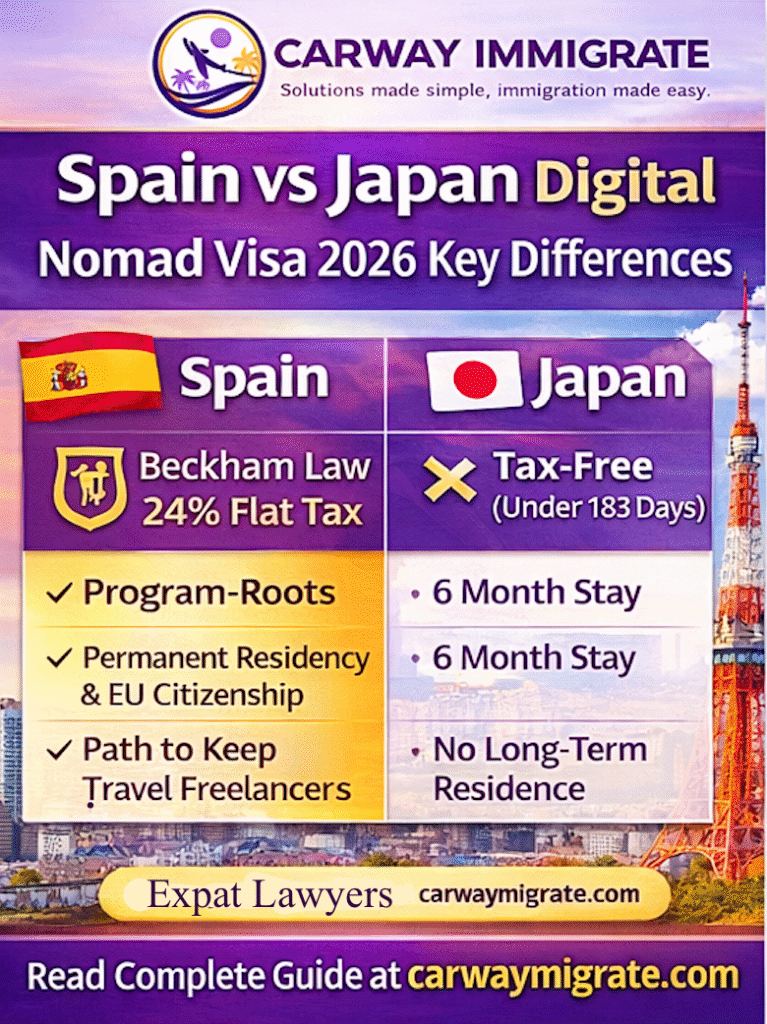
| Special Tax Regime | Yes — Beckham Law (24% flat) | No tax if under 183 days |
| Eligible Nationalities | Any non-EU/EEA national | ~50 countries with tax treaty + visa exemption |
| Family Inclusion | Yes (income scales per dependent) | Yes (no extra income required) |
| Residence Card Issued | Yes | No — treated as “super-tourist” |
| Application Fee | €73.26 | Standard single-entry visa fee |
| Processing Time | 30–45 days | 5 business days (with COE) |
| Schengen Access | Yes (26 countries) | No |
| Banking Access | Full | Very limited (no residence card) |
Part I — Spain in 2026: The Stable Bet Gets More Valuable
Why Geopolitical Turbulence Actually Favours Spain’s Visa This Year
In times of global disruption, stable EU residency becomes more valuable, not less. Spain’s digital nomad visa offers something that a 6-month Japanese permit structurally cannot: a multi-year legal home in a large, diversified Western economy with a clear pathway to permanent residency and citizenship. Spain’s digital nomad visa program is part of a broader strategy of welcoming digital nomads and integrating them into local communities, making it an attractive destination for remote workers and their families.
The Spanish economy entered 2026 with GDP growth forecast at 2.4% — one of the strongest performances in the eurozone — sustained by domestic demand, a strong labour market, and European cohesion funds. That resilience matters to digital nomads because it feeds directly into the cost and availability of accommodation, coworking infrastructure, healthcare access, and the administrative stability of the immigration system itself.
Spain is also structurally less exposed to the Iran shock than most of northern Europe. Renewables accounted for 55.5% of Spanish electricity generation in 2025, and the country imports most of its oil from the Americas and Africa rather than the Gulf. That gives Spain a meaningful buffer on electricity prices compared to Germany, France, or the UK, where gas storage levels have fallen sharply since the strikes began and power bills have already spiked.
Spain moved quickly to reduce VAT on fuel to 10% to absorb some of the pump price impact on consumers. The government has also signalled sector-specific aid for industries most exposed to the energy shock. None of this makes Spain immune — but it places it among the better-positioned European economies to weather the storm without a severe recession.
The 2026 Income Threshold: What the SMI Rise Actually Means
On 17 February 2026 — just days before the Iran strikes began — Royal Decree 126/2026 raised Spain’s national minimum wage (SMI) by 3.1% to €1,424.50/month. Because the digital nomad visa threshold is set at 200% of the SMI, the minimum income requirement rose from €2,763 to:
- Single applicant: €2,849/month (€34,188/year)
- + Spouse/partner: additional €1,069/month (75% of SMI)
- + Each dependent child: additional €357/month (25% of SMI)
- Family of 3 (couple + child): minimum €4,275/month total
The increase is modest (+€86/month vs 2025) and mechanically tied to wage policy — not a political signal against nomads. Spain continues to actively market itself as Southern Europe’s hub for location-independent talent.
One important 2026 enforcement change: authorities are now checking actual bank transaction flows, not just contracts on paper. Lump-sum transfers and inconsistent income patterns are being flagged. Bank statements must show consistent monthly deposits matching declared income. Combined household income is accepted, provided 80% originates from non-Spanish sources.
The Beckham Law: 24%, Not 15% — A Common Misconception Corrected
Spain’s headline tax advantage for digital nomads is the Beckham Law (Régimen Especial para Trabajadores Desplazados). It allows approved nomads to pay a flat 24% rate on all income up to €600,000/year — far below Spain’s standard progressive rates of 19–47%.
Many sources still cite 15% — that figure referenced an older version of the regime. The current Startup Act rate for nomads is 24%. Still highly competitive, but confirm with a qualified asesor fiscal and apply via Modelo 149 within 6 months of arrival.
| Annual Income | Beckham Law (24%) | Spain Standard | Annual Saving |
|---|---|---|---|
| €50,000 | €12,000 | ~€15,000 | €3,000 |
| €80,000 | €19,200 | ~€28,000 | €8,800 |
| €120,000 | €28,800 | ~€45,000 | €16,200 |
The Beckham Law applies for the year of arrival + 5 subsequent years (6 years total). After year six, standard progressive rates apply — plan ahead.
The Visa Track: Built to Last
- Spain’s Digital Nomad Visa is part of the country’s Startup Act and is designed as a long term visa to attract remote workers and boost local economies. This long term visa allows holders to stay in Spain for up to one year while working remotely for a company based outside of Spain, with the potential to apply for temporary residency after the initial period.
- Consulate application (from abroad): 1-year visa, then modified to 3-year residence permit on arrival
- Application from within Spain (legal presence): Direct 3-year residence authorisation
- Renewal: 2-year extensions
- Year 5: EU Long-Term Residence eligibility
- Year 10: Spanish citizenship — just 2 years for nationals of Latin American countries, Philippines, Andorra, Equatorial Guinea, Portugal, and Sephardic Jews
Application fee: €73.26 — one of the lowest nomad visa fees in the world.
Part II — Japan in 2026: The Six-Month Dream with a Volatile Backdrop
Japan’s Unique Position in the Global Storm
Japan occupies a strange position in the current crisis. The economists predicted eurozone inflation to peak at over 4% year-on-year in 2026, 3% in the US, and 2.5% in Japan — making Japan one of the most inflation-insulated major economies in the world, partly because it has spent decades fighting deflation rather than inflation, and partly because the Bank of Japan has more policy room than Western central banks. Japan has also introduced a new digital nomad visa, which allows remote workers to stay for up to six months, offering digital nomads a limited but immersive cultural experience.
The economic fallout from the US and Israel’s war on Iran is rippling across the world, but the effects are especially pronounced in Asia. From New Delhi to Bangkok, governments are bracing for a new wave of inflation driven by disruptions in the Strait of Hormuz. Japan is not exempt from this — it imports roughly 90% of its energy, and the yen has been under pressure — but its response capacity is greater than most Asian neighbours.
For a digital nomad on a 6-month Japan visa, this translates into a specific reality: your Japanese stay will likely be more expensive than you budgeted, particularly for transport, utilities, and short-term accommodation (which is already stretched by Japan’s ongoing tourism boom). The upside: Japan’s infrastructure is designed for efficiency even under pressure, and the country’s renowned social stability means disruptions to daily life remain minimal by global standards.
A Digital Nomad Visa That Was Designed as a Time Capsule, Not a Home
Japan launched its digital nomad visa on 1 April 2024 under “Designated Activities” status (Notice No. 53). Two years on, the program is structurally unchanged — and that is both its clarity and its limitation.
The visa allows a maximum stay of 6 months, non-extendable, non-renewable without a 6-month gap outside Japan. Holders are not classified as mid-to-long-term residents, receive no Residence Card (Zairyu Card), and have no pathway to permanent residency or citizenship through this category.
In practical terms, digital nomad visa holders in Japan cannot open a local bank account, cannot easily secure a long-term apartment lease, and cannot obtain a Japanese phone number — because all of these require the Residence Card that the nomad visa does not grant. Most nomads rely on Wise, Revolut, short-term serviced apartments, and international SIM cards. This was manageable before the Iran conflict; with flights to and from Japan disrupted on some Gulf and Middle Eastern routes, it adds logistical friction for nomads who planned connecting through Dubai or Abu Dhabi.
The ¥10 Million Floor: Still the Highest Bar in Europe’s Nomad Landscape
A Japan sets a high bar: your last full year of gross earnings must clear ¥10 million — roughly $67,000–$70,000 USD at current rates. And a fat bank balance alone won’t cut it. Authorities want to see that the money flows in regularly from active work, not that it arrived once and sat there.
At current EUR/JPY rates (approximately 158–165 yen per euro as of early 2026), ¥10 million equals roughly €60,000–€63,000/year — nearly double Spain’s €34,188/year threshold. Only active professional income counts: dividends, interest, and passive sources are excluded.
This places Japan’s nomad visa firmly in the high-earner bracket. And in a year of currency volatility — with the yen weakening against the dollar and euro due to the energy shock — the effective EUR threshold could shift meaningfully between when you calculate eligibility and when your application is processed.
Who Can Even Apply: The Nationality Filter
According to official information, Japan’s digital nomad visa is available to citizens of 49 countries and regions with whom Japan has visa waiver agreements.If you hold a US, Canadian, British, Australian, Singaporean, South Korean or Taiwanese passport, you’re in — but always verify the current list with Japan’s Ministry of Foreign Affairs before applying, as it gets updated periodically.
Crucially excluded: China, India, Vietnam, Indonesia, Pakistan, most of Africa, and much of Southeast Asia. This is not a minor caveat — it eliminates the majority of the world’s remote workers from eligibility entirely, a limitation Spain’s program does not impose.
Japan’s Invisible Tax Advantage: Zero, If You Play It Right
Japan has no special tax regime for nomads — but it has something potentially more powerful: if you stay fewer than 183 days, you are not a Japanese tax resident. Your foreign income attracts zero Japanese income tax.
Japan maintains double taxation treaties with over 60 countries (US, UK, Canada, Australia) to prevent dual taxation on the same income. Tax tips: track your days in Japan to confirm non-resident status and reference your home country’s tax treaty with Japan for exemptions.
The 6-month cap was almost certainly calibrated to keep nomads under the 183-day tax residency threshold by design. It is the rare case where a visa’s limitation is also its biggest financial feature.
| Annual Income | Spain Beckham (24%) | Japan (0%, sub-183 days) | 6-Month Japan Advantage |
|---|---|---|---|
| €60,000 | €14,400 | €0 | +€14,400 |
| €80,000 | €19,200 | €0 | +€19,200 |
| €100,000 | €24,000 | €0 | +€24,000 |
The catch: this 0% applies to 6 months only. The remaining 6 months of your year must be accounted for elsewhere — in your home country, in Spain, or in a third destination. Tax planning across a split-year residency is genuinely complex and requires professional advice.
Part III — What the Iran Conflict Changes (and Doesn’t)
The Cost of Living Recalculation
The global economy in early 2026 was already walking a tightrope — post-pandemic debt still heavy, trade wars still simmering, inflation only recently tamed. The Iran conflict did not create fragility; it found it. For digital nomads, the fallout runs through three concrete channels.
Energy and utilities. Electricity and gas costs have risen across Europe and Asia. Under a sharper oil shock scenario, with Brent reaching $100 and gas prices elevated, eurozone inflation could average 2.4% across 2026 with a second-quarter peak above 3%, with growth slowing to around 0.8%. Spain’s renewable energy mix softens this blow relative to Germany or France, but utility bills in Barcelona and Madrid are higher than they were six months ago. However, Spain offers low living costs overall and is generally more affordable than Japan, making it a more attractive option for budget-conscious digital nomads seeking a cost-effective lifestyle.
In Japan, officials have closed schools and told workers to stay home while asking people to adopt fuel-saving measures as they anticipate surging oil prices to push up the prices of nearly everything from food to transport to electricity. Japan imports nearly all its energy, making it structurally vulnerable to sustained Hormuz disruption.
Flights and travel costs. The war has not only sent oil prices surging but has also upended global travel, pushing airline ticket costs on some routes sky-high. More than two weeks into the conflict, the Gulf’s biggest carriers are still struggling to return to pre-war flight volumes with airspaces either shut or operating under major restrictions. For nomads flying between Europe and Asia, this is a real cost increase — particularly if your preferred routing went through Dubai, Doha, or Abu Dhabi.
Currency and purchasing power. The yen has weakened further against the euro and dollar since the conflict began, which simultaneously makes Japan’s ¥10M income threshold slightly easier to meet in EUR/USD terms and makes daily life in Japan cheaper for those earning in hard currencies. Spain’s euro-denominated threshold is fixed in nominal terms but vulnerable to eurozone inflation eroding its real value.
Does This Make Japan More or Less Attractive as a Temporary Base?
Honest answer: it cuts both ways. Japan’s insulation from the Gulf — geographically distant, politically neutral, with significant energy reserves and alternative supply routes — makes it a relatively stable short-term base compared to, say, living in a country directly dependent on Middle Eastern energy or facing Gulf airspace disruption. Asian and other stock markets falling more than the US reflects their larger exposure to the energy crisis — but Japan specifically has more monetary policy buffers than its Asian neighbours. Digital nomads in Japan can also explore vibrant major cities like Tokyo and Osaka while working remotely, enjoying high-speed internet, cultural amenities, and the convenience these urban hubs offer.
For a 6-month Japan nomad stay, the key risk is practical: flights may cost more, accommodation is already expensive due to tourism demand, and the absence of a bank account makes managing rising costs in real time more cumbersome. Japan’s digital nomad visa also comes with a significant language barrier outside major cities, making daily life more challenging compared to Spain, where Spanish is generally easier to learn or navigate. For high earners with strong cash flow and logistical flexibility, none of this is fatal. For nomads running tighter margins, Japan’s infrastructure friction during a global shock is harder to absorb.
Does This Make Spain’s Long-Term Bet More Compelling?
For nomads thinking beyond 12 months: yes. Europe faces energy security threats, with eurozone growth potentially reduced, but the impact is projected to be far more manageable than in 2022 — not least because Europe has diversified its energy mix significantly since the Ukraine war. Spain’s renewable base, its Americas-focused oil import structure, and the Spanish government’s active consumer protection measures (VAT cut on fuel, sector aid) all reinforce the argument for Spain as a durable base.
The Spanish economy anticipates GDP growth of 2.4% in 2026, employment growth of 2.3%, and unemployment falling to 9.8% — supported by consumption, investment, and demographic growth driven by immigration. That labour market strength matters for digital nomads who build local ecosystems around their base: coworking spaces stay open when economies grow, local service businesses remain viable, and the overall quality of urban life holds up better in growing economies.
The Iran conflict has not made Spain more expensive in ways that undermine its nomad visa proposition. It has made stability itself a scarcer good — and Spain is selling stability in 2026.
Matching the Right Visa to the Right Profile
The Spain DNV is your move if you:
- Earn €34,188–€60,000/year — above Spain’s threshold, below Japan’s
- Want EU residency and a citizenship pathway, especially as a Latin American national (2 years)
- Need a stable multi-year legal base for family, schooling, or business continuity
- Value Spain’s structural energy resilience relative to northern Europe in the current crisis
- Want a bank account, lease, and residence card from day one
The Japan DNV is your chapter if you:
- Earn €60,000+/year and qualify from one of the ~50 eligible nationalities
- Want zero Japanese income tax for 6 months while tracking days carefully
- Are drawn to Japan’s cultural and logistical extraordinary and willing to plan around the infrastructure friction
- Already have a permanent base elsewhere and treat Japan as a high-value seasonal destination
- Travel with family and want dependents included without extra income requirements
- Can absorb higher flight costs and accommodation prices due to the current conflict’s travel disruption
The Strategic Combination — For High Earners With Planning Appetite
In 2026, both Spain and Japan are recognized as offering some of the best digital nomad visas available, each appealing to different types of remote workers. The best digital nomad strategy for high earners may involve leveraging both programs for maximum flexibility and tax optimization. For nomads earning €80,000+/year, the math supports doing both: 6 months in Japan (0% Japanese tax), 6 months in Spain under the Beckham Law (24% on half a year’s income), maintaining Spain as the long-term base. In a year of global economic uncertainty, the option to return to a multi-year Spanish residence permit at the end of your Japanese adventure is worth more than the visa costs alone suggest.
Spain vs Japan Digital Nomad Visa: Frequently Asked Questions
Has Japan’s digital nomad visa been updated for 2026?
No structural changes. The 6-month cap remains non-extendable, and no official announcement of a renewal pathway or duration extension has been made as of 2026. The income threshold (¥10M/year) and eligible nationality list are unchanged, though the list has grown modestly to over 50 countries.
Does the Iran conflict affect visa processing for either country?
Not directly — neither Spain’s consulates nor Japan’s embassies have announced changes to processing timelines linked to the conflict. Indirectly, flight disruptions through Gulf hubs may complicate travel logistics for some applicants from Middle Eastern or South Asian countries.
Is Spain’s Beckham Law rate 15% or 24%?
24% on income up to €600,000/year, under the Startup Act framework applicable to digital nomad visa holders. The 15% figure circulating in many online guides referenced an earlier iteration of the regime. Verify with a Spanish tax advisor (asesor fiscal) and apply via Modelo 149 within 6 months of first arrival.
Can I avoid all Japanese income tax on the nomad visa?
Yes, if you stay fewer than 183 days in Japan in a calendar year. Under that threshold, Japan does not classify you as a tax resident, and your foreign income is not subject to Japanese income tax. Japan’s network of 60+ double taxation treaties supports this for most Western nationals.
Does Japan’s nomad visa come with a residence card?
No. Japan treats digital nomad visa holders as enhanced tourists, not residents. Without that official resident classification, you won’t get a Zairyu Card — and without that card, opening a Japanese bank account, signing a standard lease, or getting a local phone contract all become surprisingly difficult tasks.Which country is more exposed to the Iran conflict’s economic effects?
Spain is structurally better positioned. Its high renewable energy share, Americas-focused oil imports, and active government intervention (VAT cuts, sector aid) cushion the energy shock. Japan, as a near-total energy importer, faces greater structural exposure — but its monetary policy headroom and social stability mean the practical impact on daily nomad life remains manageable for a 6-month stay.
Spain vs Japan Digital Nomad Visa: The Bottom Line
Spain and Japan are not competing on the same turf in 2026 any more than they were in 2025. But in a year defined by a Middle East conflict that has tested global energy systems, driven up costs of living, and accelerated the premium placed on stable, predictable legal environments, the contrast between the two programs sharpens.
Spain offers what geopolitical uncertainty makes more valuable: a multi-year EU residence track at a manageable income threshold (€2,849/month), a flat 24% Beckham Law tax, the full infrastructure of European residency — bank accounts, healthcare, coworking ecosystems — and a clear road toward the most powerful document a nomad can hold in 2026: an EU passport.
Japan offers what no European country can replicate: six legal, tax-free months in one of the world’s most extraordinary places — at the cost of a high income bar (¥10M/year), nationality restrictions, significant infrastructure friction, and the knowledge that on day 181 you have to leave.
Both Spain and Japan offer digital nomad visas in 2026, and many other countries now offer digital nomad visas as well, giving remote workers a wide range of options to live and work legally around the world.
If you have to choose one visa to build a life in uncertain times: Spain. If you have the income and the appetite for Asia’s most compelling chapter: Japan. If you earn €80,000+ and have access to good tax advice: consider doing exactly both.
Last updated: March 2026. Spain’s income threshold (€2,849/month) reflects Royal Decree 126/2026, effective 1 January 2026. Japan’s ¥10M requirement and 6-month non-renewable structure remain unchanged since April 2024. EUR/JPY conversion figures (~160 yen/euro) are exchange-rate sensitive — verify at time of application. Economic and conflict data reflects conditions as of mid-March 2026; the situation in the Middle East remains fluid. Always consult a qualified immigration attorney and tax advisor before applying to either program.