
Introduction: Two Mediterranean Choices, One Big Decision
Spain and Malta remain two of Europe’s most popular digital nomad visa destinations in 2026. Both offer Mediterranean sunshine, EU membership, Schengen access, and legal frameworks purpose-built for remote workers. But under the surface, the two programs have diverged significantly — especially in income thresholds, tax treatment, and long-term settlement potential.
This fully updated 2026 guide incorporates the latest regulatory changes, including Spain’s revised SMI-linked income threshold (updated February 2026) and Malta’s consolidated Nomad Residence Permit rules — so you have accurate, current Spain vs Malta digital nomad visa 2026 figures before applying.
Quick Comparison Table (2026)
| Feature | Spain Digital Nomad Visa | Malta Nomad Residence Permit |
|---|---|---|
| Program Launch | January 2023 | 2021 |
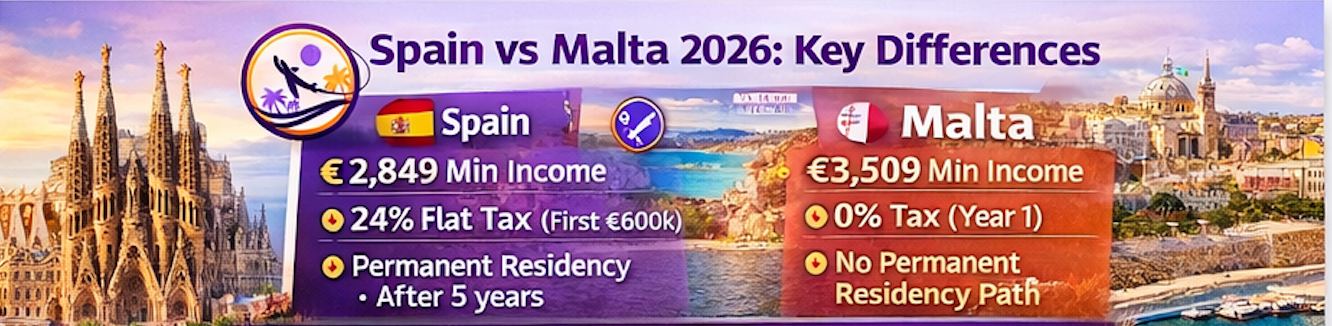
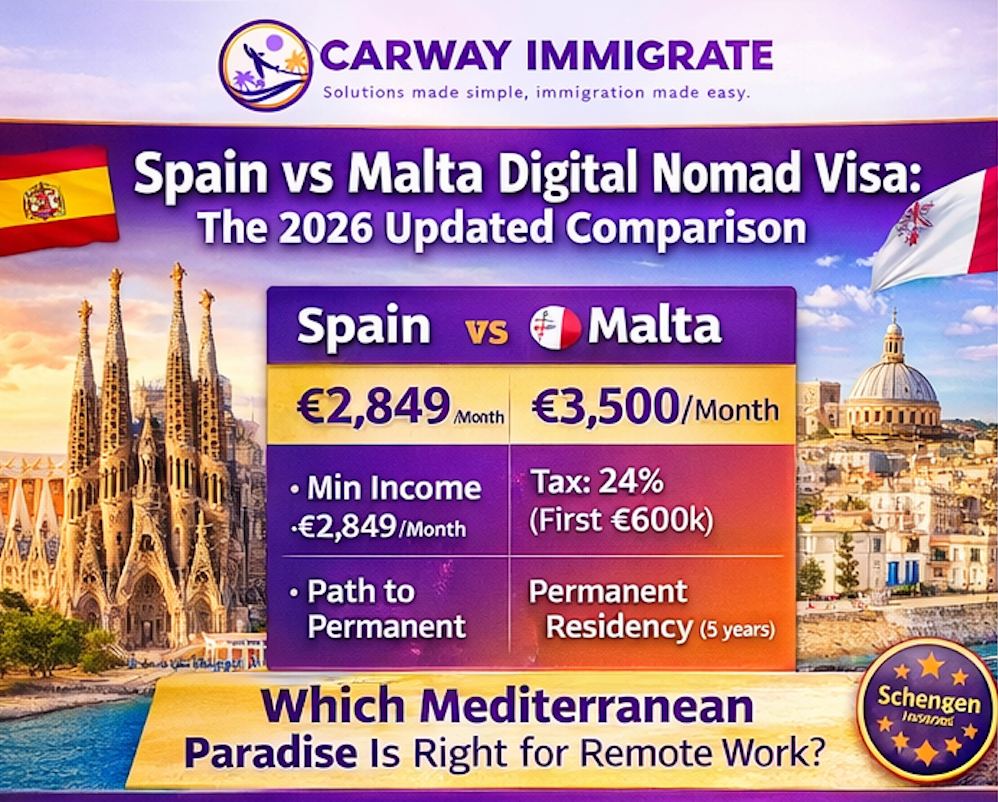
| Min. Monthly Income (2026) | €2,849 (200% SMI) | €3,500 (€42,000/year) |
| Min. Annual Income | €34,188 | €42,000 |
| Dependent Income Add-on | +€1,069/mo (spouse) / +€357/mo (child) | No increase required |
| Initial Duration | 1 year (consulate) / 3 years (from within Spain) | 1 year |
| Max Total Duration | Up to 5 years (then PR eligible) | Up to 4 years (3 renewals) |
| Special Tax Regime | Yes — Beckham Law (24% up to €600k) | Yes — NRP Tax Rules (10% flat after Year 1) |
| Year 1 Tax Exemption | No | Yes — full exemption on authorised income |
| Path to Permanent Residency | Yes (5 years) | No |
| Path to Citizenship | Yes (10 years; 2 for LatAm) | No via this permit |
| Min. Physical Stay | 183+ days to trigger tax residency | At least 5 months/year to renew |
| Application Fee | €73.26 per applicant | €300 per applicant (non-refundable) |
| Processing Time | 30–45 days | 30–60 working days |
| English as Official Language | No | Yes |
| Schengen Access | Yes | Yes |
| Family Inclusion | Yes (spouse + children) | Yes (separate requirements) |
What Changed in 2026: Key Updates
Spain: New Income Threshold (February 2026)
On 17 February 2026, Spain’s Council of Ministers approved Royal Decree 126/2026, raising the national minimum wage (SMI) by 3.1% to €1,424.50/month. Because Spain’s digital nomad visa threshold is formally pegged at 200% of the SMI, the minimum monthly income for a single applicant rose from €2,763 to €2,849/month (€34,188/year) — effective from 1 January 2026 retroactively. This updated figure represents the new minimum income requirement for Spain’s digital nomad visa, a key eligibility criterion that applicants must meet.
This is the second adjustment since the visa launched in 2023. Immigration lawyers note that bank statements must now reflect consistent cash flow matching the declared income, not just payslips on paper — authorities are scrutinising the actual movement of funds more rigorously than in prior years.
Spain: Stricter Enforcement in 2026
Beyond the income threshold change, 2026 has brought tighter application scrutiny:
- Bank statements must demonstrate real, consistent income — not one-off transfers or lump sums
- The 80% foreign income rule is being enforced more closely — at least 80% of total professional income must come from foreign employers or clients, not Spanish sources
- W-2 employed applicants (US employees) can now qualify, following official confirmation from Spanish immigration authorities, provided their employer authorises remote work from Spain and has operated for at least 12 months
- Spain’s Golden Visa (investor visa) was closed to new applicants in 2025, making the digital nomad visa the primary route for non-EU remote workers
Malta: Revised Tax Rules (effective 2024, fully operational 2026)
Malta’s Nomad Residence Permits Income Tax Rules came into force on 1 January 2024 and are now fully embedded in practice. The key provisions:
- Year 1: Full tax exemption on all authorised remote work income — no Maltese income tax in the first 12 months from permit issuance
- Years 2–4: Flat 10% tax on qualifying income derived from authorised remote work. Digital nomads are required to pay taxes in Malta on qualifying income after the first year.
- Minimum physical presence requirement: 5 months/year (cumulative) to qualify for renewal
- Income threshold was raised to €42,000/year (€3,500/month) with effect from 1 April 2024 — replacing the previous €32,400 threshold. Applications submitted before that date retained the old threshold under transitional provisions, now expired.
Spain Digital Nomad Visa 2026: Full Requirements
Who Can Apply
Non-EU/EEA nationals who:
- Are foreign remote workers, meaning they work remotely for an employer or clients based outside Spain
- Have been with their current employer or operating as a freelancer for at least 3 months
- Derive at least 80% of their income from non-Spanish sources
Income Requirements (2026 — Updated)
- Single applicant: €2,849/month gross (€34,188/year)
- + Spouse/partner: additional €1,069/month (75% of SMI)
- + Each dependent child: additional €357/month (25% of SMI)
- Family of 3 (2 adults + 1 child): minimum €4,275/month total
Income is verified through: employment contracts, employer authorisation letters, last 3–6 months of bank statements, invoices (for freelancers), and payslips. Combined household income is accepted as long as 80% originates from outside Spain.
Spain’s minimum income requirement is lower than Malta’s higher income threshold for digital nomad visa applicants.
Educational/Professional Qualifications
Applicants must hold either:
- A recognised university or postgraduate degree, or
- Minimum 3 years of documented professional experience in their field
Other Requirements
- Private health insurance valid in Spain (until you register with the public system)
- Clean criminal record (from country of nationality + countries of residence in the last 2 years)
- No criminal record in Spain
- Valid passport
Visa Structure and Renewals
- Applied from abroad (consulate): Visa duration is 1 year, after which you can modify to a 3-year residence permit upon arrival in Spain.
- Applied from within Spain: Visa duration is a direct 3-year residence authorisation.
- Renewal: 2-year extensions are available after the initial visa duration.
- Year 5: Permanent residency eligibility (EU long-term residence) becomes possible after maintaining legal residence for five years.
- Year 10: Spanish citizenship eligibility (or 2 years for Latin American, Filipino, Andorran, Equatoguinean, Portuguese nationals and Sephardic Jews) is available after the required period of legal residence.
Application Fee
€73.26 (Tasa 790-038), per applicant — one of the lowest in Europe.
Do you meet the requirements?
Let us review your profile and tell you exactly where you stand — no jargon, no guesswork.
Get a Case Review →Tax: The Beckham Law (2026)
One of the main tax benefits for digital nomads in Spain is the Beckham Law (Régimen Especial para Trabajadores Desplazados), which remains available to digital nomad visa holders in 2026. Key facts:
- Flat 24% rate on income up to €600,000/year (non-resident income tax rate)
- 47% rate on income above €600,000 (effectively irrelevant for most nomads)
- Valid for the year of arrival + 5 subsequent years (6 years total)
- Must apply via Modelo 149 within 6 months of first Spanish entry
- Cannot have been a Spanish tax resident in the prior 5 years
Important 2026 note: Some sources still quote 15% as the Beckham Law rate. The correct rate under the Startup Act framework for digital nomads is 24% on Spain-sourced income up to €600,000 — not 15%. The 15% figure applied to a narrower prior version. Confirm with a qualified Spanish tax advisor (asesor fiscal) before applying.
Malta Nomad Residence Permit 2026: Full Requirements
Who Can Apply
Non-EU, non-EEA, and non-Swiss nationals who wish to live and work remotely from Malta can apply for the Malta Nomad Residence Permit, which is a remote work residence permit designed specifically for digital nomads and remote workers. Eligible applicants include those who:
- Work remotely as an employee of a foreign company (with a foreign employment contract), OR
- Are a director/shareholder of a company registered outside Malta, OR
- Provide freelance or consulting services to foreign clients with whom they have contracts
Persons contracted by a foreign company to serve that company’s Maltese subsidiary are explicitly not eligible.
Income Requirements (2026 — Updated)
- Single applicant: €3,500/month gross (€42,000/year) — this is the minimum income requirement for Malta’s digital nomad residence permit; it is a fixed threshold, not indexed
- With dependents: The income threshold for the main applicant does not increase with dependents — a notable advantage vs Spain’s system
Only professional income qualifies. Dividends, bank interest, passive rental income, and investment returns are not accepted as qualifying income.
Income is demonstrated through: bank statements (official, stamped — not screenshots), employment contracts, client contracts, or director/shareholder agreements.
Other Requirements
- Valid passport (minimum 1 year remaining validity beyond permit duration)
- Clean criminal record
- Private health insurance: fully pre-paid, covering the full 1-year permit period, for all applicants and their family members included in the application. Coverage minimums are set by the Residency Malta Agency and updated periodically (see official schedule at nomad.residencymalta.gov.mt)
- Proof of accommodation in Malta: lease agreement for minimum 1 year (no minimum rent threshold), or property purchase documentation
- No work for Maltese companies or service to Maltese clients/individuals permitted
Permit Structure and Renewals
- Initial permit: Valid for up to a year
- Renewable: Up to 3 times (total maximum 4 years under this permit category)
- Minimum physical stay: 5 months/year (cumulative) to qualify for renewal
- Renewal deadline: Application must be submitted at least 2 months before expiry; all supporting documents filed no later than 21 days before expiry
- No pathway to permanent residency through the Nomad Residence Permit
- No citizenship pathway through this permit
After the maximum 4-year period, nomads must leave or transition to a different Maltese residency category (e.g. the Malta Permanent Residence Programme, which has different requirements).
Application Fee
€300 per applicant (non-refundable), paid by bank transfer directly from the main applicant’s account. Processing takes 30 working days from receipt of payment; can extend to 60 days if additional documents are requested.
Tax: Malta’s NRP Tax Rules (2024–2026)
Malta’s dedicated tax framework for nomad permit holders offers special tax incentives designed to attract remote workers:
Year 1 (from permit issuance date):
- Full income tax exemption on all income from authorised remote work
- This is a genuine 0% rate on qualifying professional income — one of the most generous first-year special tax incentives for digital nomads in Europe
Years 2–4 (renewal periods):
- 10% flat income tax on qualifying authorised work income — another special tax incentive that keeps Malta highly competitive for digital nomads
Key conditions:
- Spending 183+ days in Malta in any calendar year triggers standard Maltese tax residency, subjecting you to standard progressive rates (0–35%) on a remittance basis
- Malta operates a territorial/remittance tax system: foreign income not remitted to Malta is generally not taxable, even if you become a tax resident
- Nomads must register with the Malta Tax and Customs Administration (MTCA) after receiving the permit
- Malta has double taxation treaties with over 70 countries — check whether your home country is covered
Digital Nomads and Permanent Residency: Can You Stay for Good?
As the digital nomad lifestyle becomes more mainstream, many remote workers are looking beyond short-term adventures and asking: can a digital nomad visa lead to permanent residency? The answer depends heavily on the country and the specific visa program.
Most digital nomad visas are designed for temporary stays—typically ranging from a few months up to a few years. While these programs are excellent for remote workers seeking flexibility and legal residence in a foreign country, only a handful offer a genuine pathway to permanent residency or citizenship.
Spain stands out in Europe for digital nomads seeking long-term settlement. It allows non-EU remote workers to live and work in Spain for up to one year initially, with the option to renew and convert to a residence permit for up to five years. After five years of continuous legal residence, digital nomad visa holders become eligible to apply for permanent residency (EU long-term residence). Throughout this process, applicants must maintain a stable monthly income above the required threshold, valid health insurance, and a clean criminal record.
Do you meet the requirements?
Let us review your profile and tell you exactly where you stand — no jargon, no guesswork.
Get a Case Review →Malta’s Nomad Residence Permit, by contrast, is strictly temporary. While it offers attractive tax breaks and a streamlined application process, the permit is capped at four years and does not provide a direct route to permanent residency or citizenship. Digital nomads who wish to stay in Malta long-term must transition to a different residency visa category, such as the Malta Permanent Residence Programme, which has its own set of requirements and higher income thresholds.
Across Europe, the landscape is mixed. Some countries, like Portugal, offer digital nomad visas or remote work residence permits that can eventually lead to permanent residency—often after five years—provided you meet ongoing income requirements, maintain valid health insurance, and integrate into the local community. Other European countries, such as Germany, France, and Italy, offer various residence permits for remote workers, but the path to permanent residency can be more complex and time-consuming. To learn more about it, check our article: Best Digital Nomad Visa Europe 2026 Comparison
Head-to-Head: Spain vs Malta in 2026
1. Income Threshold: Malta Is Now Significantly Higher
The gap has widened. Spain requires €2,849/month; Malta requires €3,500/month — a difference of €651/month (€7,812/year). For a solo nomad on a moderate freelance income, Spain is considerably more accessible.
Spain also allows combined household income and accepts a broader range of proof documents. Malta’s restriction on passive income sources (dividends, interest) counts only active professional income — which can catch out some applicants.
2. Tax: Malta Has the Edge — But Only With Careful Planning
The tax comparison in 2026 is genuinely interesting:
| Year | Spain (Beckham, 24%) | Malta Year 1 (0%) | Malta Years 2–4 (10%) |
|---|---|---|---|
| €50,000/year | €12,000 | €0 | €5,000 |
| €70,000/year | €16,800 | €0 | €7,000 |
| €100,000/year | €24,000 | €0 | €10,000 |
Over 4 years, a nomad earning €70,000/year pays approximately €50,400 under Spain’s Beckham Law versus €21,000 under Malta’s NRP rules (0% year 1 + 10% years 2–4) — a difference of nearly €29,400.
However: The tax benefit requires active management in Malta. Local income tax in Malta applies only to income remitted to Malta or if you trigger tax residency by spending over 183 days per year in the country. Nomads must carefully track physical presence, understand the remittance rules, and engage a Maltese tax advisor to ensure the 10% rate applies cleanly.
Spain’s advantage: The Beckham Law is a known quantity — 24% flat on all income for 6 years, with straightforward application via Modelo 149. No presence tracking required. No remittance calculations.
3. Settlement and Long-Term Future
Spain wins decisively. Spain’s visa leads directly to permanent residency after 5 years and citizenship after 10. The entire journey is within a single permit framework.
Malta’s NRP is a temporary residence permit, capped at 4 years maximum with no permanent residency pathway. After 4 years, you must start again in a different category or move on. For nomads who want to build a permanent European base, this is a fundamental limitation.
4. Application Cost
Spain is dramatically cheaper. At €73.26 per applicant, Spain’s application fee is one of the lowest nomad visa fees in the world. Malta charges €300 per applicant, non-refundable — meaning a family of 3 pays €900 just to apply.
5. Processing Speed
Spain is faster. Consulate applications typically process in 30–45 days. Malta takes 30–60 working days from payment receipt — and can extend further if documents are queried, meaning real-world timelines of 2–3 months are common.
6. English Language
Malta is the clear winner for English speakers. Both Maltese and English are official languages. Government services, the application process, tax registration, banking, and daily life operate fully in English. Spain’s bureaucracy is predominantly Spanish — while immigration advisors help, many processes require Spanish documentation or language competency over time.
7. Physical Presence Requirements
Both programs have minimum stay requirements, but structured differently:
- Spain: No formal minimum stay requirement to maintain the visa, but 183+ days triggers tax residency (and Beckham Law compliance obligations)
- Malta: 5 months/year (cumulative) minimum stay is required to renew the permit — this is a hard renewal condition, not a tax threshold
For nomads who want to split time between multiple countries, Spain is structurally more flexible on minimum presence. Malta’s 5-month minimum is a meaningful constraint for frequent travellers.
8. Family Economics
Malta is better for families on the income dimension. Malta does not increase the income threshold for dependents — a single applicant earning €3,500/month can bring a spouse and children on the same income. Spain adds €1,069/month for a spouse and €357 per child, meaning a family of 4 must prove approximately €4,632/month — nearly €1,800 more than Malta’s flat €3,500 threshold for any family size.
9. Cost of Living
Both are mid-range Mediterranean destinations. Malta has become notably more expensive in recent years, particularly for accommodation. A 1-bedroom apartment in Valletta or Sliema runs approximately €1,300–€1,600/month in 2026. Spain’s major cities (Barcelona, Madrid) are comparable, but Spain’s regional diversity — Seville, Málaga, Valencia, Alicante — offers significantly cheaper options at €700–€1,100/month for equivalent accommodation, providing an affordable cost of living for digital nomads.
Who Should Choose Spain in 2026?
- Mid-income freelancers (€2,849–€3,499/month) who don’t meet Malta’s €3,500 threshold
- Anyone wanting a genuine long-term settlement path — permanent residency at 5 years, citizenship at 10
- Latin American nationals qualifying for the 2-year citizenship pathway
- Nomads who want lower application fees and faster processing
- Those who prefer flexibility on minimum physical presence
- Families with children where the income is above €4,000/month and the Beckham Law 24% rate is acceptable
- Remote workers seeking well-established digital nomad communities in Spain, offering networking, support, and social integration
Who Should Choose Malta in 2026?
- High earners (€3,500+/month) with tax efficiency as the top priority — the 0% first year + 10% thereafter is significantly lower than Spain’s 24% Beckham Law
- English-speaking nomads who want zero language friction in bureaucracy, banking, and daily life
- Nomads who intend to manage presence carefully and don’t plan to trigger Malta’s 183-day tax residency
- Those who want Mediterranean island life with a compact, safe, English-first community
- Remote workers seeking a digital nomad hub — Malta is emerging as a digital nomad hub in the Mediterranean, offering coworking spaces, reliable internet, and a growing remote work community
- Families on a single income covering all dependents (Malta doesn’t scale the threshold)
- Nomads treating this as a 1–4 year stint with no expectation of permanent settlement in Malta
Frequently Asked Questions
Has Spain’s minimum income for the digital nomad visa changed in 2026?
Yes. Following Royal Decree 126/2026 (published in the BOE on 17 February 2026), Spain’s SMI increased by 3.1% to €1,424.50/month. The digital nomad visa threshold is set at 200% of the SMI, bringing it to €2,849/month (€34,188/year) for a single applicant, up from €2,763 in 2025.
Is the Beckham Law rate 15% or 24% for digital nomads in Spain?
As of 2026, the applicable Beckham Law rate for digital nomad visa holders is 24% on income up to €600,000/year (the non-resident income tax rate under the Startup Act). Some older sources cite 15%, which referenced a pre-Startup Act iteration. Always confirm with a qualified Spanish tax advisor.
Does Malta’s NRP now have a 10% flat tax?
Yes — but not from day one. Under the Nomad Residence Permits Income Tax Rules (effective 1 January 2024), Year 1 is fully tax-exempt on authorised remote work income. From Year 2 onwards, a 10% flat rate applies to qualifying income. Standard Maltese rates apply to any non-qualifying income or if you exceed the 183-day tax residency threshold.
Can I stay in Malta without a minimum time commitment?
No. Malta requires a minimum of 5 cumulative months per year in Malta to qualify for permit renewal. This is a formal renewal condition — failure to meet it means your permit will not be renewed.
Is Malta’s income threshold the same for families?
Yes — unlike Spain, Malta’s €3,500/month income threshold does not increase with dependents. The main applicant’s income covers the entire family unit for the purposes of the income requirement.
Can I combine Spain’s digital nomad visa with Estonian e-Residency for company management?
Yes. Spain’s digital nomad visa and Estonia’s e-Residency program are fully compatible. Many nomads in 2026 use this combination: Spanish residency under the Beckham Law for tax efficiency + an Estonian e-Residency entity for EU business operations and banking. Estonia also offers a digital nomad visa with its own eligibility criteria, further expanding options for remote workers seeking access to the EU. Consult a tax advisor to ensure the structure is correctly documented.
Which country is easier to leave after the visa expires?
Both are straightforward to exit. Spain’s visa simply lapses if not renewed or converted to permanent residency. Malta’s NRP ends after a maximum of 4 years with no automatic extension — nomads must either transition to another Maltese residency category or leave.
Final Verdict: 2026 Edition
The Spain vs Malta comparison has sharpened considerably in 2026. Malta’s revised tax rules — 0% in Year 1, 10% thereafter — now represent a genuinely compelling tax case for high earners, particularly those earning €60,000+/year who are committed to spending at least 5 months in Malta annually.
However, for the majority of digital nomads, Spain remains the stronger choice in 2026:
- Lower income threshold (€2,849 vs €3,500)
- Lower application cost (€73 vs €300)
- A settlement pathway that ends in EU citizenship
- Greater flexibility on physical presence
- Beckham Law offers 24% flat — competitive but straightforward and no worldwide
- High quality of life, with excellent healthcare, infrastructure, and safety
- Rich cultural heritage, including numerous UNESCO World Heritage sites such as the Alhambra, Sagrada Familia, and historic city centers
Choose Malta if: you earn €3,500+/month, prioritise minimising tax over the next 1–4 years, value an English-first environment, and treat the permit as a medium-term base rather than a permanent home.
Choose Spain if: you want to build a permanent European life, earn below €3,500/month, are Latin American, or want the clarity and simplicity of Spain’s established visa track, while enjoying a high quality of life and access to Spain’s rich cultural heritage and UNESCO World Heritage sites.
Ready to start your Spain visa application?
Carway Immigration has handled hundreds of successful visa cases. Let our lawyers guide yours.
Schedule My Consultation →Last updated: March 2026. Spain’s SMI-linked income threshold is reviewed annually — the €2,849/month figure reflects the official 2026 rate following Royal Decree 126/2026. Malta’s €42,000/year threshold has been in force since 1 April 2024. Always verify current figures with the relevant consulate and consult a qualified immigration lawyer and tax advisor before applying.