

Spain vs Portugal digital nomad visa: Which is best for you in 2026? This guide is for remote workers, freelancers, and entrepreneurs considering a move to Spain or Portugal in 2026. Choosing the right digital nomad visa can impact your taxes, residency rights, and quality of life.
Choosing the right digital nomad visa can impact your taxes, residency rights, and quality of life. This guide is for remote workers, freelancers, and entrepreneurs considering a move to Spain or Portugal in 2026. A digital nomad visa is a residence permit introduced by countries like Spain and Portugal to attract remote workers from outside the EU. Both Spain and Portugal have introduced digital nomad visas to attract remote workers from outside the EU, offering unique advantages for international professionals seeking flexibility and a high quality of life.
Spain and Portugal have become top choices for digital nomads due to their sunny weather, affordable living, and vibrant nomad communities. Both Portugal and Spain provide digital nomad visa options with distinct eligibility criteria, terms, and benefits tailored for remote workers.
With so many factors to consider, this article serves as a digital nomad visa comparison, breaking down eligibility requirements, lifestyle preferences, and other key factors to help you make an informed decision.
Both Spain and Portugal offer vibrant lifestyles and active digital nomad scenes, but the vibe and infrastructure can differ significantly between cities.
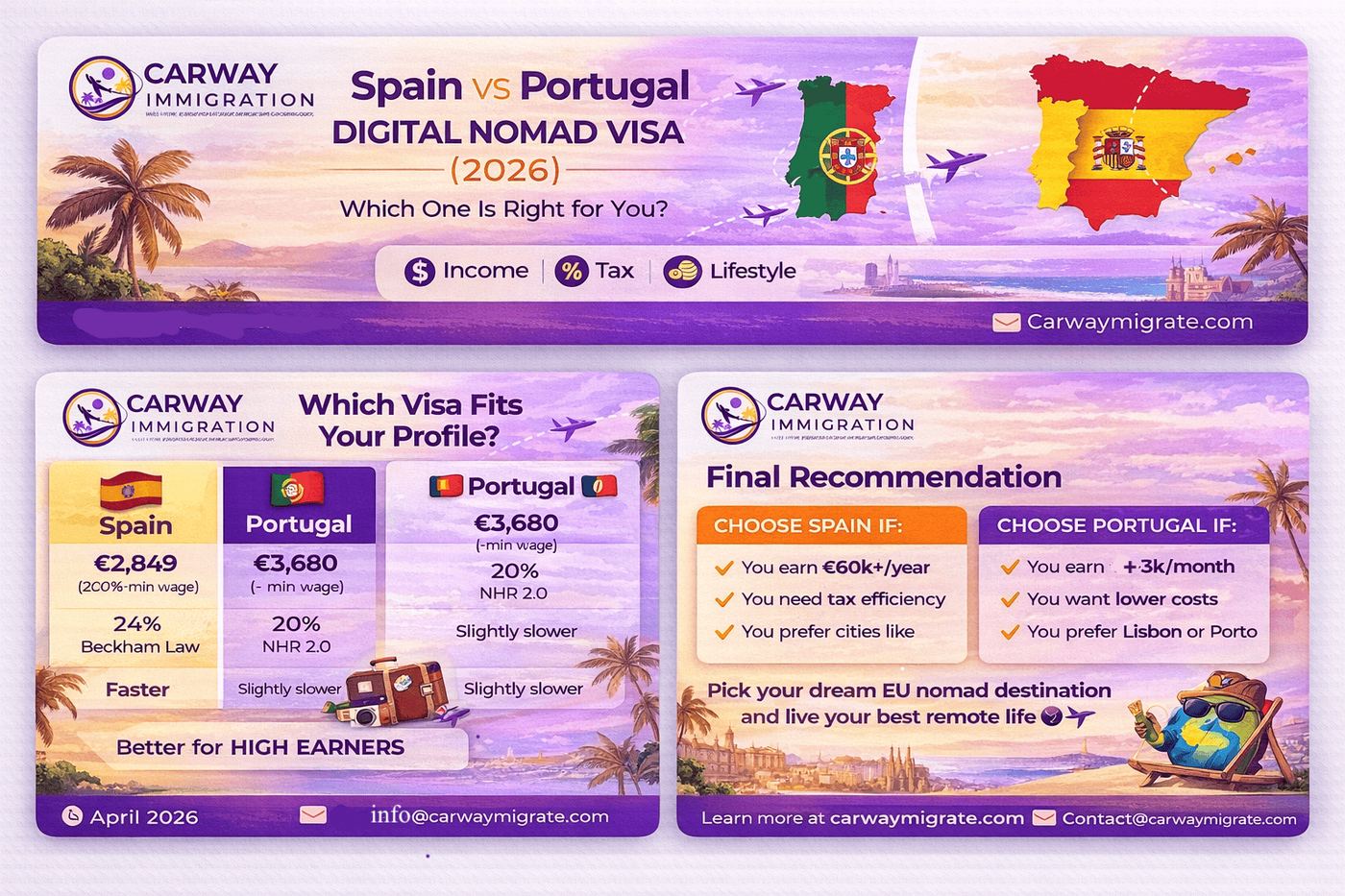
Spain vs Portugal Digital Nomad Visa: Quick Comparison Table
| Feature | Spain Digital Nomad Visa | Portugal D8 Visa |
|---|---|---|
| Launch Year | 2023 | 2022 |
| Min. Monthly Income | €2,849 (~200% min wage) | €3,680 (4x min wage) |
| Initial Visa Duration | 1 year or 3 years within Spain | 1–2 years |
| Renewal | Up to 2 + 3 years | Up to 2 years (renewable) |
| Special Tax Regime | Yes — Beckham Law (24% up to €600,000) | Yes — NHR 2.0 (20% for 10 years, stricter rules; most global income taxed at 14.5–48%) |
| Path to PR/Citizenship | PR: 5 years, Citizenship: 10 years | PR: 5 years, Citizenship: 5 years |
| Language | Spanish | Portuguese |
| Avg. Processing Time | 1–4 months from Consulate and 20 days from Spain | 30–60 days (delays) |
| Application Fee | ~€73–€160 | ~€75–€320 |
| English Proficiency | Moderate | Moderate–High (Lisbon/Porto) |
Note: Both Spain and Portugal require applicants to meet specific income thresholds and provide proof of income and accommodation as part of the digital nomad visa eligibility criteria. For Portugal, you may also need to demonstrate sufficient funds by showing a minimum balance in a Portuguese bank account. Ensuring you have the required documentation, including bank account statements, is essential to avoid delays or rejections during the visa application process.
Introduction: Two Iberian Giants, Two Very Different Paths
Spain vs Portugal Digital Nomad Visa: if you’re a remote worker eyeing Europe as your next home base, chances are Spain and Portugal have both crossed your radar. These neighboring countries launched their digital nomad visa programs within months of each other, yet they differ significantly in cost, tax treatment, lifestyle, and application complexity.
This in-depth guide breaks down every key factor so you can make the smartest decision for your situation.
Spain Digital Nomad Visa: Full Breakdown
Eligibility Criteria
- Applicants must be non-EU/EEA/Swiss citizens and work for clients or employers located outside Spain.
- Spain’s digital nomad visa — officially the Visado para Teletrabajo de Carácter Internacional — launched in January 2023 under the Startup Act. It targets remote workers and freelancers who earn their income primarily from clients or companies outside Spain.
Income Requirements
- You must demonstrate a monthly income of at least €2,849, which equals 200% of Spain’s national minimum wage. You can also qualify at 200% of the minimum interprofessional wage, verified through bank statements, contracts, or invoices from the past 3–6 months.
Application Process
- Submit your application online or at a Spanish consulate.
- Provide proof of income, accommodation, health insurance, and remote work.
- Processing time is generally 1–4 months from submission to approval.
Key Benefits
Tax Benefits: The Beckham Law
- Spain offers a special tax regime known as the Beckham Law, which allows qualifying individuals to be taxed at a flat rate of 24% on income up to €600,000 per year for six years.
- Standard Spanish residents pay 19–47% depending on income bracket.
- This is a game-changer for high earners.
Key Beckham Law conditions:
- You must not have been a Spanish tax resident in the prior 5 years.
- At least 80% of your income must come from non-Spanish sources.
- You must apply within 6 months of arriving.
Work Authorization
- You may work for Spanish companies, but no more than 20% of your total income can come from Spanish clients.
- Spain’s digital nomad visa allows holders to work for a company based in Spain, provided that this work accounts for no more than 20% of their total professional activity.
Family Reunification
- Spouse and dependent children can be included in the same application.
Path to Permanent Residency and Citizenship
- After 5 years of continuous legal residency, you can apply for permanent residency.
- In Spain, citizenship can be obtained after ten years of residence, with some exceptions for nationals of former Spanish colonies.
Next, let’s see how Portugal’s D8 Visa compares.
Portugal D8 Visa: Full Breakdown
Eligibility Criteria
- Applicants must be non-EU/EEA/Swiss citizens and work for clients or employers located outside Portugal.
- Portugal’s D8 Digital Nomad Visa launched in October 2022, making it one of the first purpose-built nomad visas in the EU. It targets remote workers, freelancers, and self-employed professionals working for non-Portuguese clients.
Income Requirements
- Portugal sets the bar at a minimum income requirement of four times the national minimum wage, which is currently €3,680/month. Applicants must demonstrate this income requirement by providing bank account statements or other financial documents as part of the visa application process.
Application Process
- Submit your application at a Portuguese consulate or online.
- Provide proof of income, accommodation, health insurance, and remote work.
- Processing time is generally 30–60 days.
Key Benefits
Tax Benefits: NHR 2.0
- Portugal’s tax regime for new residents has stricter requirements under the NHR 2.0 and offers a 20% flat tax for 10 years.
- However, Portugal’s digital nomad visa no longer includes the old Non-Habitual Resident (NHR) tax perks, meaning most global income is now taxed under regular Portuguese rates, which range from 14.5% to 48%.
- Primarily benefits those in qualifying professions (tech, science, arts, research).
NHR 2.0 Key Points:
- 20% flat tax on Portuguese-sourced income for 10 years.
- Partial exemptions on foreign-sourced income (depending on source).
- Stricter eligibility and fewer exemptions than the original NHR.
Work Authorization
- You must demonstrate that your income comes primarily from remote work or self-employment serving clients outside Portugal.
- Portugal’s D8 Visa allows remote workers to live in Portugal while working for non-Portuguese employers or clients, providing a legal residence option without entering the local labor market.
Family Reunification
- Portugal’s family reunification laws are flexible. Dependents can apply alongside the main applicant or subsequently.
Path to Permanent Residency and Citizenship
- Digital nomads in Portugal can apply for permanent residency and citizenship after five years of legal residence—one of the shortest paths to EU citizenship available.
Now that we’ve covered both visas in detail, let’s explore other EU options and practical considerations.
EU Digital Nomad Visa Options: Beyond Spain and Portugal
While Spain and Portugal are among the most popular choices for digital nomads, the European Union offers a growing list of alternative digital nomad visa options. Countries like Croatia, Greece, and Estonia have introduced their own nomad visa programs, each designed to attract remote workers and entrepreneurs seeking flexibility and a European lifestyle.
Croatia’s digital nomad visa, for example, requires applicants to demonstrate a minimum monthly income of around €2,300, making it accessible for many remote professionals. The visa is typically granted for up to one year, with the possibility of renewal. Greece has also entered the scene, offering a digital nomad visa with a minimum income requirement of €3,500 per month, plus additional amounts for family members. This visa allows digital nomads to live and work in Greece for up to 12 months, with the option to renew.
Estonia stands out with its innovative e-Residency program, which, while not a traditional residence permit, enables non-EU citizens to establish and manage an EU-based business remotely. Estonia also offers a digital nomad visa for those who wish to live in the country while working for foreign employers.
When considering these EU digital nomad visa options, it’s important to compare not only the minimum monthly income requirements but also the visa duration, application process, and tax implications. Each country has its own approach to taxing foreign income and determining tax residency, so digital nomads should carefully review the rules to ensure compliance and optimize their financial situation. By exploring the full range of EU nomad visa programs, remote workers can find the destination that best matches their lifestyle, work needs, and long-term goals.
Healthcare for Digital Nomads in Spain and Portugal
Access to quality healthcare is a top priority for digital nomads relocating to a new country. Both Spain and Portugal offer robust healthcare systems, giving digital nomads peace of mind while living and working abroad. In Spain, digital nomads can access the public healthcare system by registering as residents, which provides comprehensive medical coverage at low or no cost. However, many Spain digital nomads opt for private health insurance to ensure faster access to specialists and English-speaking doctors, especially during the initial period before full public coverage is established.
Whether you choose Spain or Portugal, it’s essential to research the health insurance requirements for your digital nomad visa, understand the process for accessing public healthcare, and budget for private health insurance as part of your overall living expenses. By planning ahead, digital nomads can enjoy the benefits of both Spain’s and Portugal’s high-quality healthcare systems while focusing on their remote work and travel adventures.
Spain vs Portugal Digital Nomad Visa: Education Opportunities for Digital Nomad Families
For digital nomad families, ensuring children have access to quality education is a key consideration when choosing a new home base. Both Spain and Portugal offer a variety of educational options to suit different needs and preferences. In Spain, families can enroll their children in public schools, which are free and provide instruction in Spanish or regional languages. There are also numerous private and international schools, particularly in major cities, offering bilingual or English-language curricula that cater to expat communities.
Portugal similarly provides a range of choices, with public schools available to residents and a growing number of international schools in Lisbon, Porto, and the Algarve. These schools often follow British, American, or International Baccalaureate programs, making transitions smoother for children from abroad. Additionally, both Spain and Portugal have supportive environments for homeschooling and online education, giving digital nomad families the flexibility to maintain continuity in their children’s learning while traveling or relocating.
When evaluating education options, families should consider factors such as language of instruction, curriculum, school reputation, and associated costs. By exploring the diverse educational opportunities in both Spain and Portugal, digital nomad families can ensure their children receive a high-quality education while enjoying the benefits of an international lifestyle.
Retirement Considerations for Digital Nomads
As digital nomads plan for the future, retirement becomes an important part of the conversation. Both Spain and Portugal are renowned for their appealing retirement options, offering a blend of warm climates, rich cultural experiences, and affordable living. Digital nomads who have established legal residence through a digital nomad visa or other residence permit can often transition to permanent residency after several years, unlocking additional benefits such as access to public healthcare and social services.
Both Spain and Portugal recognize years spent under a digital nomad visa toward the residency requirements for permanent residency and citizenship, making them attractive choices for those seeking stability in their later years.
When considering retirement in either country, digital nomads should evaluate factors such as pension eligibility, tax implications on worldwide income, and access to healthcare. Both Spain and Portugal have tax treaties with many countries, which can help avoid double taxation on pensions and other retirement income. By planning ahead and choosing the right residence permit or visa, digital nomads can enjoy a comfortable and fulfilling retirement in a destination that matches their lifestyle and financial goals.
Not sure which visa applies to your situation?
Book a consultation with us and get a clear answer in 40 minutes.
Book Your Consultation →Spain vs Portugal Digital Nomad Visa: Processing Time and Application
Spain: Processing Time & Application Steps
When planning your move as a digital nomad, understanding the processing time and application steps for each country’s digital nomad visa is crucial. For Spain, the digital nomad visa application typically takes between 1 and 4 months from submission to approval. Spain’s processing for the Digital Nomad Visa typically takes 20 working days after application submission.Spain has emerged as more flexible when it comes to documentation, especially regarding income proof and accommodation.
To maximize your chances of a swift approval, ensure you meet all eligibility criteria, including proof of minimum monthly income, valid passport, comprehensive health insurance, and evidence of remote work. Spain’s process is known for its efficiency, but missing documents or unclear financial records can cause delays.
Portugal: Processing Time & Application Steps
Portugal’s digital nomad visa application process is generally completed within 30 to 60 days, though occasional backlogs may extend this period. Applicants must demonstrate a minimum monthly income of at least four times the Portuguese minimum wage, provide proof of remote work, and show evidence of private health insurance. As with Spain, having all your paperwork in order—such as bank statements, employment contracts, and a valid passport—will help ensure a smooth process.
Both countries require digital nomads to submit a complete application package, so careful preparation is key. By understanding the expected processing time and gathering all necessary documents in advance, you can better plan your relocation and take full advantage of the residence permit, temporary stay visa, and eventual pathway to permanent residency offered by these popular digital nomad destinations.
Head-to-Head: The Key Differences
| Key Factor | Spain Digital Nomad Visa | Portugal D8 Digital Nomad Visa |
|---|---|---|
| Income Threshold | €2,849/month (200% min wage) | €3,680/month (4x min wage) |
| Tax Efficiency | 24% flat tax (Beckham Law) up to €600,000 for 6 years | 20% flat tax (NHR 2.0) for 10 years, stricter rules; most global income taxed at 14.5–48% |
| Cost of Living | Higher, especially in major cities | Generally lower, especially outside Lisbon |
| Community & Ecosystem | Barcelona, Madrid: world-class infrastructure, higher cost | Lisbon, Porto: top digital nomad hubs, vibrant expat scene |
| Language & Integration | Spanish, moderate English proficiency | Portuguese, moderate-high English proficiency in cities |
| Application Complexity | Digitized, generally faster (1–4 months) | Smoother, but can face bureaucratic delays (30–60 days) |
| Path to PR/Citizenship | PR: 5 years, Citizenship: 10 years | PR: 5 years, Citizenship: 5 years |
| Best For | High earners, those seeking digitized process | Freelancers, those prioritizing cost and fast citizenship |
Digital Nomad Report and Insights
Trends
Recent digital nomad reports reveal a surge in remote workers choosing Spain and Portugal for their flexible visa options and high quality of life. Both countries have seen a notable increase in digital nomad visa applications, reflecting their growing appeal among freelancers, entrepreneurs, and remote employees worldwide.
Cost of Living
Living costs remain a significant factor, with Portugal generally offering more affordable options outside Lisbon, and Spain providing a range of choices depending on the region. Both countries grant visa holders the benefit of visa-free travel within the Schengen Area, making them attractive bases for exploring Europe.
Tax Implications
Tax implications are a key consideration for digital nomads. Spain’s Beckham Law and Portugal’s Non-Habitual Resident (NHR) program offer special tax regimes, but it’s essential for digital nomads to understand their tax obligations and residency status to remain compliant. The report emphasizes the importance of meeting eligibility criteria, such as minimum income requirements and maintaining legal residence, to access benefits like permanent residency and even EU citizenship.
By analyzing these trends and real experiences, digital nomads can make informed decisions about where to settle, ensuring they choose the right digital nomad visa for their lifestyle, income level, and long-term goals. Whether you prioritize affordable living, digital infrastructure, or a fast track to EU citizenship, both Spain and Portugal remain top choices for remote workers in 2026.
Who Should Choose Spain?
- High earners (€50k+/year) who want to maximize the Beckham Law’s 24% flat tax up to €600,000
- Digital nomads who want access to Mediterranean lifestyle (Barcelona, Seville, Valencia)
- Remote workers with existing ties to Spain’s culture, language, or business ecosystem
- Individuals who want a faster, digitized application process
- Recommended for higher earners seeking lower income thresholds and a digitized application process
- Spain’s Digital Nomad Visa is generally better for high earners
Who Should Choose Portugal?
- Mid-income freelancers (€1,000–€3,000/month) who can’t meet Spain’s threshold
- Nomads who value a lower cost of living and more budget-friendly cities
- Those qualifying for NHR 2.0 in priority sectors (tech, science, arts)
- Anyone prioritizing the 5-year citizenship pathway with a friendlier cost base
- Advised for freelancers prioritizing lower cost of living and a faster path to EU citizenship
- Portugal’s D8 Digital Nomad Visa is ideal for freelancers and low tax seekers
Frequently Asked Questions
Can I apply for both visas?
No. You cannot hold both visas simultaneously. You must choose one country as your primary residence.
Is Spain’s Beckham Law automatic with the digital nomad visa?
No. You must apply separately for the Beckham Law tax regime within 6 months of your first entry into Spain. It is not automatically granted.
Does Portugal’s NHR 2.0 still apply if I’m a freelancer?
Yes, but only if your profession qualifies under the IFICI framework. Consult a Portuguese tax advisor to verify eligibility.
Which country is better for families?
Both offer excellent public services. Portugal’s lower cost of living can make it more comfortable for families on moderate incomes. Spain offers excellent international schools and infrastructure in major cities.
Can I travel freely within the Schengen Area with either visa?
Yes. Both visas grant Schengen Area access, allowing travel to 26 European countries for up to 90 days within a 180-day period outside your country of residence.
Final Verdict
Choosing between Spain and Portugal depends on numerous personal factors, including income level, work type, future settlement plans, and lifestyle preferences.
Choose Spain if you’re a high earner who wants the best flat tax rate in Western Europe and access to a vibrant, cosmopolitan lifestyle.
Choose Portugal if you’re a mid-income digital nomad who wants a lower income threshold, a strong expat community, and one of Europe’s most accessible citizenship pathways.
Both are excellent choices — your income level and lifestyle priorities will be the deciding factor.
Last updated: 2026. Always consult an immigration lawyer or tax advisor before applying, as regulations change frequently.
Ready to start your Spain visa application?
Carway Immigration has handled hundreds of successful visa cases. Let our lawyers guide yours.
Schedule My Consultation →