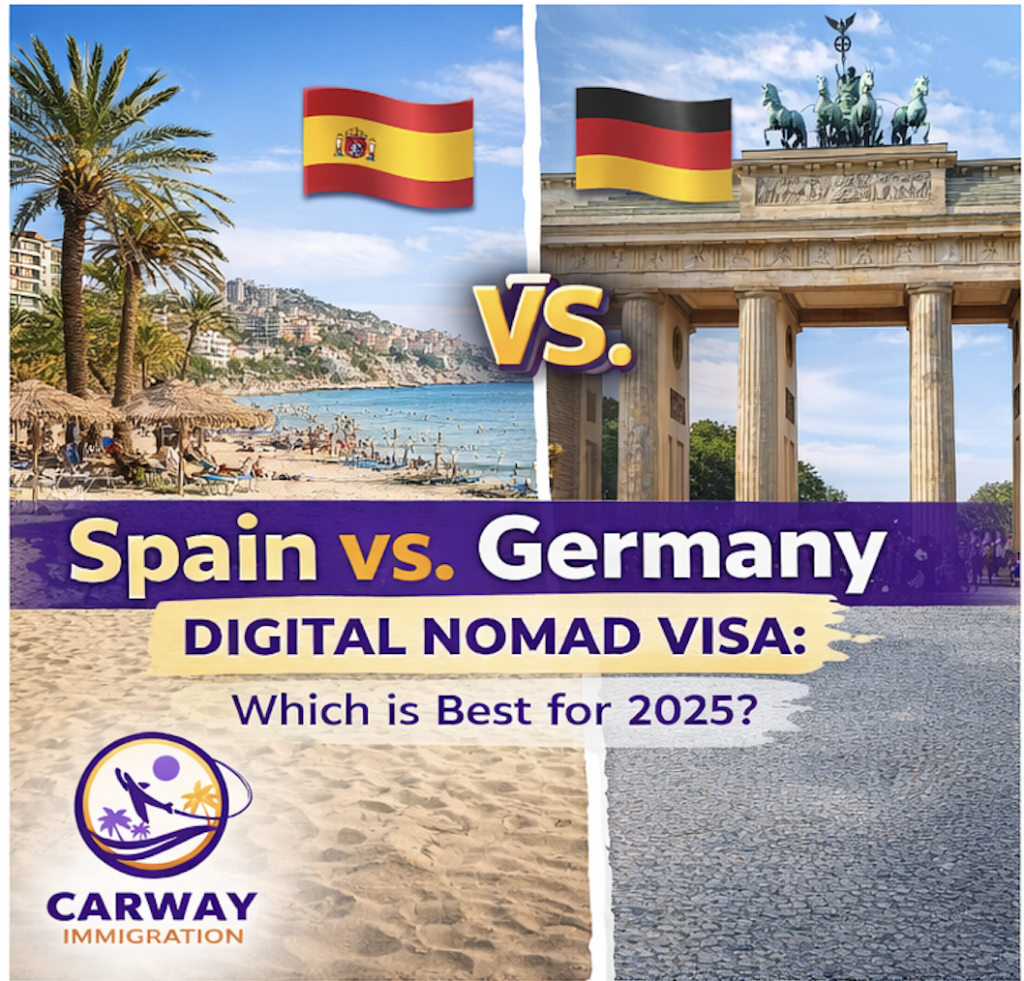

This guide is for remote workers, freelancers, and entrepreneurs considering a move to Spain or Germany. We compare visa requirements, tax regimes, cost of living, and lifestyle factors for digital nomads in 2026
Introduction: A Tale of Two Cultures – Sunshine or Efficiency?
Spain and Germany are two sides of the European coin, each with its own unique take on life. One offers sun-kissed beaches, tapas, and a laid-back Mediterranean lifestyle. The other is all about punctuality, precision engineering, and being the economic powerhouse of Europe. Both countries are popular destinations for digital nomads seeking the experience of living and working remotely in a foreign country, but they go about it in very different ways – Germany doesn’t even have a dedicated digital nomad visa as such. However, Germany offers the Freiberufler visa for non-EU remote workers.
This guide compares Spain’s purpose-built digital nomad visa with Germany’s equivalent option, the Freiberufler visa, to help you decide which European path is right for your remote work goals.
Germany vs Spain Digital Nomad Visa- Comparison Table – Quick Look
Quick Comparison Table
| Feature | Spain Digital Nomad Visa | Germany Freelance Visa (Freiberufler) |
|---|---|---|
| Visa Type | Purpose-built digital nomad visa for remote work for a company based outside of Spain | Self-employment / Freelance visa |
| Launch Year | 2023 | Long-standing program |
| Min. Income Required | Approximately €2,850/month as of 2026 (minimum income required) | Sufficient to cover living costs (~€2,000+); requires company registered abroad and convincing business case |
| Work Restriction | 85% income from non-Spanish sources | Can work with German clients |
| Initial Duration | Up to one year, renewable for up to five years total | 1–3 years |
| Special Tax Regime | Yes — Beckham Law (24%) | No |
| Standard Tax Rate | 19–47% (Beckham: 24%) | 14–45% + solidarity surcharge |
| Path to PR | Yes (5 years) | Yes (5 years) |
| Citizenship | Yes (10 years) | Yes (8 years) |
| Cost of Living | Medium | Medium–High |
| Processing Time | 30–45 days | 4–12 weeks |
| Language | Spanish | German |
| Visa Fee | €80–€100 (non-refundable) | €75–€100 (non-refundable) |
Spain Digital Nomad Visa – The Lowdown
Spain launched its digital nomad visa back in January 2023 specifically for non-EU nationals working remotely for employers or clients outside the country. This is a programme designed from scratch with remote workers like you in mind. Spain’s Digital Nomad Visa is open to non-EU/EEA citizens, including U.S. citizens and Green Card holders.
What You Need:
- Valid passport
- Proof of income (such as payslips, work contracts, or bank statements)
- Proof of remote work authorization from a foreign employer
- Evidence of employment with or running a business for a foreign company
- Valid health insurance covering your stay in Spain
Applicants must provide proof of remote work authorization from a foreign employer, and the visa allows remote workers to maintain employment with a foreign company while living in Spain.
Successful applicants receive a digital nomad residence permit, which allows travel within the Schengen Area for up to 90 days in any 180-day period.
What You Need
- Minimum monthly income: approximately €2,850 (as of 2026)
- Valid passport\
- Proof of income: bank statements, payslips, employment contract, or 3 months of invoices
- Proof of remote work authorization from a foreign employer\
- No more than 20% of total professional activity from Spanish clients (freelancers can work for Spanish companies, but only up to this limit)\
- Health insurance valid in Spain\
- Clean record
The Beckham Law: Spain’s Tax Break
The Beckham Law is a real game-changer for Spain’s digital nomad visa. Qualifying digital nomads can pay a flat 24% income tax rate on Spanish-sourced income up to €600,000 per year for up to 6 years, instead of Spain’s standard 19–47% progressive rate. Importantly, under this tax scheme, foreign earnings are exempt from Spanish taxation, providing a significant tax exemption for income generated outside Spain. This tax benefit is a major incentive for digital nomads seeking financial advantages. To benefit from the Beckham Law, you must apply within six months of registering with Spanish Social Security or starting qualifying employment activity.
Prospects for the Future
Spain’s Digital Nomad Visa can be renewed for up to five years total, providing a clear path to permanent residency (5 years) and citizenship (10 years). Successful applicants receive a digital nomad residence permit, which can include dependent children. Dependent children can be included in the application, and their residence status is tied to the primary applicant. Even better, families can be included in the application.
Germany Freelance Visa (Freiberufler) – The Alternative
Germany doesn’t have a digital nomad visa, but you can use its Freiberufler visa—a self-employment visa for freelancers, artists, journalists, lawyers, engineers, and other freelancers. To qualify, applicants must have a company registered abroad and present a convincing business case. However, it’s important to note that the Freiberufler visa is not specifically designed for foreign remote workers; instead, it targets those who wish to establish a freelance business in Germany. Many European countries are capitalizing on remote work by offering digital nomad visas to attract foreign workers, providing a legal pathway for remote workers to live and work in Europe.
What Qualifies as a Freelance Profession?
Germany has strict rules about what qualifies as a freelancer (Freiberufler). This typically includes:
- Software developers and web designers\
- Journalists and authors\
- Architects and engineers\
- Lawyers, doctors, and tax advisors\
- Artists and musicians
This is not a visa for all remote workers – if your work doesn’t fit into these categories, you may need to apply as a Gewerbetreibender (commercial entrepreneur), which involves different rules and a trade tax.
Key Requirements
- Proof of sustainable income, at least €2,000–€2,500 a month to cover living costs in Germany. Applicants must show sufficient funds to support themselves during their stay, typically by providing bank statements as proof of income.
- Evidence of existing clients or contracts, either German or international ones
- Relevant professional qualifications or portfolio
- Health insurance valid in Germany (either statutory or private)
- Proof of a place to live
- Proof of a local bank account to demonstrate financial stability
- Registration with the local tax office as a freelancer
The visa application process involves submitting the required documentation, paying the application fees, and waiting for processing. Successful applicants will also be required to pay local taxes in Germany.
Unlike Spain’s visa, Germany’s Freiberufler visa means you can work with German clients, which can be a big advantage for those building a European client base.
Taxes in Germany
Germany doesn’t have any special regime for digital nomads—which is a major disadvantage, especially considering that Germany’s tax rates can be as high as 45%, making it less tax-efficient for digital nomads compared to Spain’s Beckham Law. If you stay in Germany beyond a certain period, you may become a tax resident, which means you are subject to tax residency rules and may be required to pay local income tax on your worldwide income. Tax residents in Germany are obligated to pay local income tax on their global earnings, and understanding tax residency rules and the implications of paying local income tax is crucial for digital nomads.
- Income tax: 14% to 45% progressive* Solidarity surcharge: an extra 5.5% on income tax, so don’t forget that on top of your income tax bill
- Church tax (optional): 8–9% – but you get to choose whether you pay it
- Trade tax (Gewerbesteuer): 14–17% for businesses – doesn’t apply if you’re one of those lucky true Freiberufler
- VAT registration: you’ll need to do that once you hit €22,000 a year
For someone on a €60,000/year earner:
- Spain (Beckham Law): about €9,000 in income tax
- Germany (standard): around €17,500 income tax + solidarity surcharge
Germany’s tax burden is pretty much higher for most income levels—but Germany has got some great double-taxation treaties in place, so if you do business in specific countries those might come in handy.
Health Insurance in Germany
Germany has compulsory health insurance. If your income is below a certain level, you’ve got to join the public system (GKV) – above that threshold and you can choose private insurance. Germany’s healthcare system is basically top-notch.
The Actual “Digital Nomad” Situation in Germany
Here’s a key thing to remember: Germany’s Freiberufler visa isn’t for remote workers with an income from abroad just sitting on a beach somewhere. The German authorities are looking for freelancers with a business, a client base, and ideally serving German clients. If you just want to chug a coffee in Berlin and work for your US employer, Germany’s immigration system isn’t really made for you. Unlike digital nomad visas in other countries, which cater specifically to remote workers, freelancers, and entrepreneurs who earn their income online, the Freiberufler visa is not designed for remote workers seeking to work remotely for a foreign employer.
A Remote Work from Abroad situation (working for a Spanish or US company from Germany) is technically not covered by the Freiberufler visa and is actually something the authorities are getting more and more uneasy about.
Pathways to Permanent Residency
For many digital nomads, the ultimate goal isn’t just to enjoy a year or two of remote work abroad—it’s to secure permanent residency and all the long-term benefits that come with it. Holding a digital nomad visa can be the first step toward building a stable life in your chosen country, with access to public healthcare, education, and social services.
To transition from a digital nomad visa to permanent residency, you’ll need to meet a set of eligibility criteria that typically includes a minimum period of residence, proof of sufficient income, and evidence of integration into the local community. Most European countries require digital nomad visa holders to maintain a valid residence permit for five to ten years before applying for permanent residency. During this time, you’ll need to demonstrate a steady income that meets or exceeds the minimum income requirement—often ranging from €1,500 to €5,000 per month, depending on your family situation and the country’s cost of living.
Integration is another key factor. Authorities may look for signs that you’re genuinely part of the community, such as language proficiency, participation in local events, or even cultural adaptation. This helps show that you’re not just passing through, but are committed to making the country your home.
Spain stands out for digital nomads thanks to its streamlined pathway to permanent residency. After five years of legal residence on a digital nomad visa or other residence permit, non-EU citizens can apply for permanent residency, provided they’ve maintained sufficient income and met all legal requirements. The Beckham Law, while primarily a tax incentive, also supports long-term planning by offering a predictable tax regime for up to six years—making it easier to manage your finances as you work toward permanent residency.
Other countries, like Portugal, also offer straightforward routes: digital nomads can become eligible for permanent residency after five years, as long as they continue to meet the minimum income requirement and hold a valid residence permit. Each country has its own nuances, so it’s crucial to stay up to date with local regulations and consult a tax advisor to ensure you’re on the right track.
Understanding the pathways to permanent residency allows digital nomads to plan their long-term strategy, factoring in cost of living, tax breaks, and access to essential services. Achieving permanent residency not only provides security and stability, but also opens the door to deeper integration and a richer experience in your new home country.
Head-to-Head: Germany vs Spain Digital Nomad Visa
1. Visa Purpose Fit
Spain wins hands down because its visa was actually designed for remote workers. Spain’s digital nomad visa program offers a nomad residence permit specifically for remote workers, providing a legal pathway to live and work in Europe. Germany’s equivalent is a self-employment visa that just isn’t as well-suited to our lifestyle. If you’re after a visa that’s got your back, then Spain is the clear winner.
2. Tax Efficiency
Spain wins big time. Germany’s tax rates are a lot higher than Spain’s Beckham Law at pretty much all income levels. For someone on a €70,000/year earner, Germany would cost over €10,000 more per year in taxes than Spain under the Beckham Law. For high earners that gap just gets bigger.
Spain offers significant tax benefits for digital nomads, including a flat 24% tax rate on income up to €600,000 and exemption from double taxation under the Beckham Law. Additionally, foreign-sourced income may qualify for tax exemption, making Spain especially attractive for remote workers. In contrast, Germany does not provide similar tax incentives or exemptions for digital nomads.
3. Cost of Living
Comparable in the big cities. High living costs are more common in major cities like Madrid, Barcelona, Berlin, and Munich, where housing and daily expenses can be significant. However, Spain offers affordable living and an affordable cost for digital nomads, especially outside major cities. Spain’s mid-sized towns (Seville, Valencia, Málaga) offer better value than their German counterparts, and the cost of living in Spain is about 25% lower than in neighboring France.
4. English Proficiency
Germany has English down pat, they rank high in Europe for speaking English. Spain’s English skills are getting better but they’re not quite at the same level as Germany – especially in the smaller towns and government services.
5. Infrastructure and Efficiency
Germany just nails it for infrastructure, logistics and all that admin stuff. Banking, public services and registering a business are all pretty smooth (although German bureaucracy’s got its own reputation for being a bit of a nightmare). Internet speeds in the big German cities are top-notch.
6. Startup and Tech Ecosystem
Berlin’s one of Europe’s top tech hubs, second only to London. For nomads after a tech community, startup events and networking opportunities, Berlin’s the place to be.
7. Quality of Life and Lifestyle
This all comes down to personal taste. Both Spain and Germany are top destinations in Western Europe, offering high living standards and cultural richness. Spain’s got a Mediterranean lifestyle, great weather, food culture and social vibes that Germany will never be able to match, along with a rich cultural heritage that includes numerous UNESCO World Heritage sites, making it especially appealing for digital nomads. Germany’s got cultural richness, natural beauty, order and easy access to Central Europe that Spain can’t touch.
8. Process Complexity
Germany’s Freiberufler visa requires some serious documentation – a business plan, client contracts, financial projections, and sometimes even an interview. The visa application process for Germany typically involves submitting these documents, paying application fees, and waiting several weeks for processing. Spain’s digital nomad visa is a lot more straightforward and predictable these days, with an online visa application process available, requiring proof of remote work, sufficient income, health insurance, and a clean criminal record. Processing times and fees can vary, so it’s essential to gather all required documentation in advance.
Visa rules and requirements can change frequently, so always check for up-to-date information directly from official sources before starting your application.
Who Should Choose Spain?
- Remote workers after a visa that’s actually designed for us
- High earners loving the 15% flat tax under the Beckham Law
- Digital nomads that prefer the Mediterranean climate and lifestyle
- Families after a smooth path to European residency
- Anyone who wants a more standardized application process
- Visa holders benefit from the ability to travel freely within the Schengen Area for up to 90 days in any 180-day period, making it easier to explore Europe while residing in Spain
Who Should Choose Germany?
- Freelancers in a specific profession that need to serve German clients
- Tech professionals after being close to Berlin’s startup scene
- Nomads that value high English proficiency and German efficiency
- Those with good business reasons to set up in Germany’s economy
- Remote workers willing to trade off higher taxes for stability and Germany’s excellent infrastructure
- Foreign remote workers and remote workers seeking a strong business ecosystem and client base in Central Europe
Frequently Asked Questions
Can I work for German clients on Spain’s digital nomad visa?
Technically, yes, you can earn some of your income from Spanish sources as a freelancer on Spain’s Digital Nomad Visa, but work for Spanish companies must not exceed 20% of your total professional activity. The main requirement for the visa is that you work for a foreign employer or a foreign company based outside Spain. For example, if you get income from working with German clients, that’s considered foreign income. You should still consult with a tax advisor to figure out just how all this will play out.
Does Germany have any plans for a digital nomad visa all to its own ?
As things stand in 2025, many European countries now offer digital nomad visa programs that allow for temporary residency while working for a foreign company. All the countries in Europe are competing to attract remote workers with these programs, but Germany is one of the few major countries without a dedicated digital nomad visa. Until Germany decides to bring out a visa just for digital nomads like Spain’s, the Freiberufler visa is still the best route for self-employed non-EU folk to come work in Germany.
Can Americans get the Germany Freelance visa ?
Yes , you can — non-EU nationals ( and that includes Americans ) are free to apply for the Germany Freelance Visa either through the German consulate in your home country , or if your already in Germany through your local Ausländerbehörde ( the foreigners office )
Is health insurance cheaper in Spain than in Germany ?
For nomads looking for affordable health insurance, Spain is generally going to come out on top—private health insurance in Spain is usually cheaper than the mandatory insurance requirements in Germany, especially the statutory health insurance (GKV), which can be quite pricey for self-employed individuals (it’s income-based, of course).
Both Spain and Germany require digital nomad visa applicants to have valid health insurance that meets their respective national standards. In most cases, private health insurance is the preferred option for digital nomads. Specifically, applicants for the Spain Digital Nomad Visa must provide proof of health insurance that covers their entire stay in Spain to qualify.
Which country is better for people who speak German ?
Well you might think the answer is obvious — Germany ! But while Spain’s German expat communities ( especially in Mallorca which the Germans affectionately call “Malle” ) arent as big as some of the other expat communities out there , they still offer a nice little middle ground for Germans looking to live abroad
Final Verdict
Spain is the better bet for most digital nomads. It has a visa designed just for digital nomads, a flat 24% tax rate under the Beckham Law, a great Mediterranean lifestyle, and a clear route to residency—all wrapped up in a nice neat package with fewer application complexities to deal with. Digital nomad visas allow individuals to live and work remotely in a foreign country for an extended period of time, which can enhance employee satisfaction and productivity by enabling remote work from desirable locations.
Germany makes sense for tech professionals who are after Berlin’s startup ecosystem, who want to surround themselves with English speakers, or who want to tap into the German and Central European client base, and get the cachet of having a German address on their business cards—but this comes at the cost of a much higher tax burden and a less tailored visa framework to boot.
For pure tax efficiency and a visa designed with nomads in mind, Spain takes the cake. For business ecosystem, tech networking, and English language comfort, Germany holds its own.
Digital nomad visas are ideal for remote workers seeking flexibility, legal residence, and the ability to live and work in a foreign country for an extended period. Always check for up-to-date information before applying for any visa, as requirements and regulations can change frequently.
Last updated: 2025 – and German immigration law and freelance visa regulations can change – so before you apply, make sure to consult with a German immigration attorney (a Rechtsanwalt) and a tax advisor (a Steuerberater).