
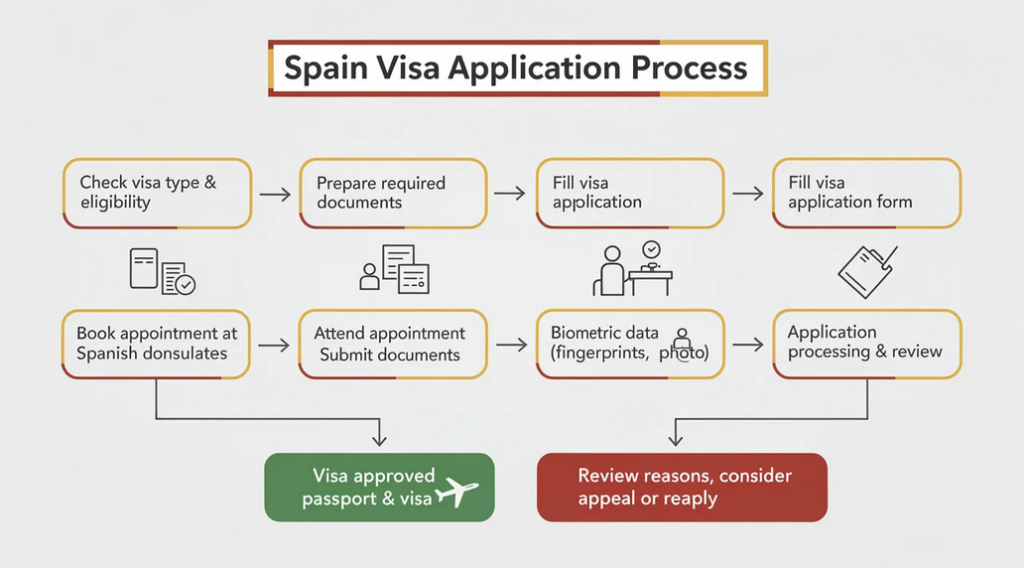

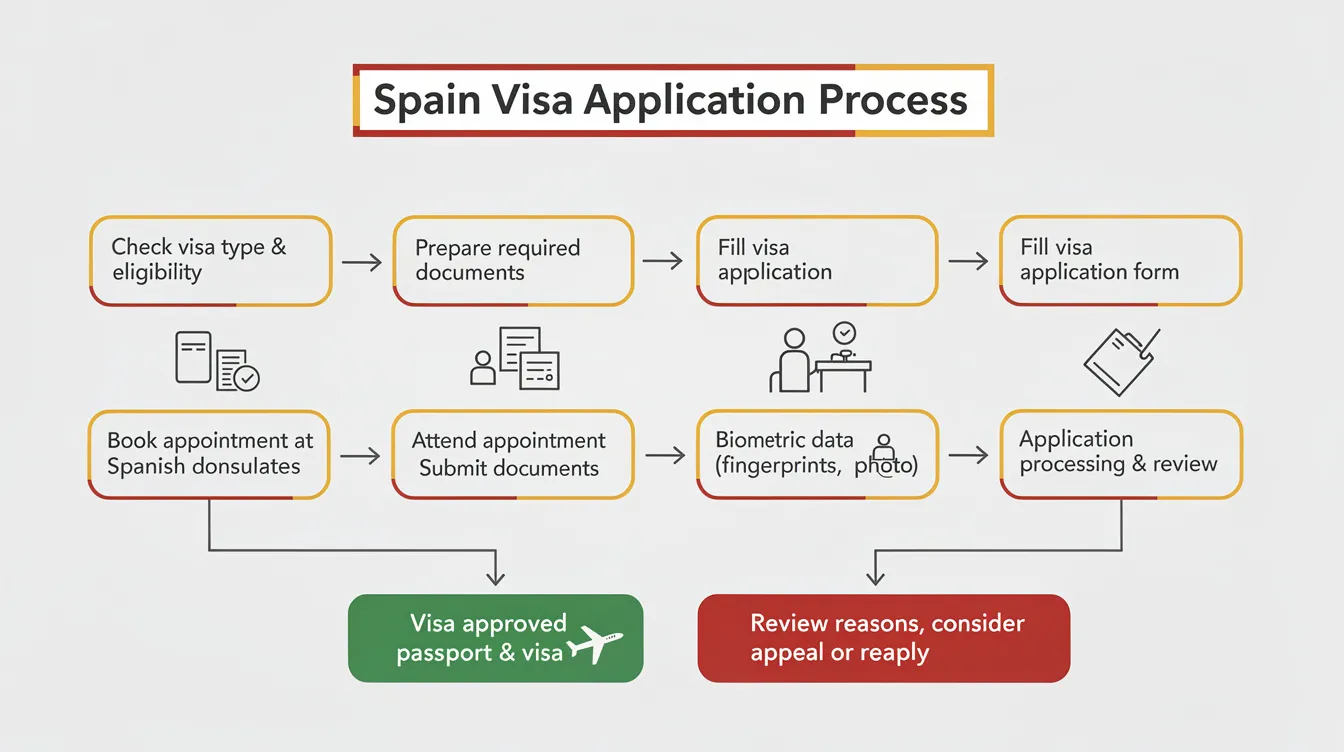
If you want to move to Spain from the UK after Brexit, you need to know that most British citizens need a long-stay Spanish visa or residence route before relocating. Short visits of up to 90 days in any 180-day period are still allowed without a visa, but that is for tourism, family visits, and limited business activities, not for settling in Spain long term. The right route depends on your purpose: a non-lucrative visa for people living from savings or passive income, a digital nomad visa for eligible remote workers, a Spain work visa for people with a Spanish job offer, or a self-employed or family-based route in the right cases.
Core requirements usually include a valid passport, criminal-record certificate, legalized or apostilled documents, official Spanish translations where required, health insurance, and proof of finances. For the non-lucrative route, Spain’s official standard is 400% of IPREM, which, for 2026, is about €28,800 per year for the main applicant. After arrival, most British movers must register on the padrón and obtain a TIE residence card. A realistic timeline ranges from a few weeks for document prep to a few months for visa and permit processing, depending on the route.
How to Move to Spain from the UK After Brexit: What Changed for British Citizens?
Brexit changed the starting point. British nationals no longer have an automatic right to live and work in Spain just because they are British. For ordinary short visits, the Schengen rule is now the key limit: up to 90 days in any 180-day period. Any stay beyond that normally requires a Spanish national visa or residence permit.
Obtaining legal residency in Spain after Brexit requires a valid residency permit issued by the Spanish government, and this is the first step towards permanent residency.
There is one major exception. If you were already living in Spain legally before 1 January 2021, you may fall under the Withdrawal Agreement and follow a different residence framework. This blog is mainly about people starting a new move now, not people preserving pre-Brexit rights. We focus on the new legal framework for moving to Spain after Brexit, and how the process for obtaining legal residency has changed.
The Right Route
Your legal route depends on what you will actually do in Spain. Picking the wrong category is one of the fastest ways to delay or weaken an application.
| Route | Best for | Main legal idea | Can you work? |
|---|---|---|---|
| Non-Lucrative Visa | Retirees, passive-income households, people not planning to work in Spain | Residence without gainful work activity | No |
| Digital Nomad Visa | Remote workers for foreign employers or foreign clients | Residence for international telework | Yes, within route rules |
| Employee work visa | People with a Spanish job offer; requires sponsorship by a Spanish employer or Spanish company | Residence tied to employment in Spain | Yes |
| Self-employed work visa | Self employed persons such as freelancers, founders, and consultants setting up in Spain | Residence plus self-employment authorization | Yes |
| Family-based route | Spouses, dependents, and qualifying family members | Residence based on family connection | Depends on route |
The process and requirements for moving to Spain differ for EU citizens and non EU citizens. UK nationals are now considered non EU citizens after Brexit, so they must follow the legal pathways and requirements for non-EU citizens.
When Is The Non-Lucrative Route The Simplest Option?
This route suits people who will not work in Spain. Spain’s official standard is 400% of IPREM for the main applicant, plus 100% of IPREM for each dependent. The current Spanish consular source states that in 2026, IPREM will be €600 per month, which puts the main applicant threshold at roughly €28,800 per year. Applicants must demonstrate sufficient financial resources to meet these requirements.
When Do You Need A Spain Work Visa?
You usually need a Spain work visa if you plan to take employment in Spain with a Spanish contract. The visa application process for a Spain work visa typically involves submitting the required documents to the Spanish consulate in the UK, with support from your Spanish employer. Spain’s London consular guidance frames this as the route for people aged 16 and over who want to work as employees in Spain. GOV.UK also notes that short business visits are not the same thing as moving for work.
Documents Required For Spain Residency For UK Citizens
The documents vary by route, but the recurring core file is very consistent across Spanish visa categories.
| Common document | Why it matters |
|---|---|
| Valid passport | Identity and travel validity |
| Visa application form | Core legal filing |
| Criminal record certificate | Background check for long-stay routes |
| Apostille / legalisation | Makes UK documents valid for Spanish use |
| Official Spanish translations | Needed for many UK-issued documents |
| Proof of health cover | Often mandatory for residence routes |
| Proof of funds or salary | Shows you can support yourself |
| Medical certificate, where required | Common on long-stay residence routes |
| Civil-status documents | Needed for spouses, children, dependants |
| Spanish NIE number | Essential for foreigners in Spain to work, study, buy property, pay taxes, and open bank accounts. Required early in the process. |
| Foreigner identity card (TIE) | Proof of legal residency status in Spain, issued after arrival and visa approval. Needed for ongoing legal stay and renewals. |
A practical point matters here: not every route asks for exactly the same evidence, but most long-stay moves involve more paperwork than people expect. Birth certificates, marriage certificates, and dependent documents often need the same legalisation and translation treatment as criminal-record paperwork if they are part of the application. This is especially relevant for couples and families moving together.
These documents, including the Spanish NIE number and foreigner identity card (TIE), are typically issued by a Spanish government office after your arrival in Spain.
Step-by-Step Move Process Guide
In the points below, you will get all the necessary details to move to Spain:
1. Choose The Route Before You Book The Move
Do not start with shipping quotes or rental searches. Start with your legal basis for residence. Spain treats long-term moves as residence cases, not as tourist stays that you “convert later.”
2. Gather UK Documents And Sort Apostilles Early
Criminal-record certificates, civil-status papers, and route-specific financial or employment documents often take longer than the online visa form. This is the stage where many timelines start to slip.
3. Apply In The UK Through The Correct Spanish Consular Channel
Spain’s UK consular network uses route-specific procedures, and, in relevant cases, Spanish visa services in the UK have been externalised through BLS. The exact office depends on your jurisdiction and visa type, so applicants should use the consular page for their area rather than copying someone else’s process from a forum. Always check the requirements and procedures at your nearest Spanish consulate or the Spanish embassy, as these may vary depending on your location and the type of visa or residency you are applying for.
Consulting immigration specialists can help ensure your application is correctly prepared and submitted, reducing the risk of delays or errors.
4. Enter Spain And Complete Local Registration
Upon arrival, most British citizens who move to Spain need to register on the padrón with their local town hall and also apply for the TIE residence card. This process is completed at the local immigration office or immigration office in your area, where you will need to apply for your Foreigners’ Identity Card (TIE) and complete the necessary residence registration. GOV.UK’s current Spain guidance says most British citizens moving to Spain will need to register as residents and get a TIE.
5. Watch The TIE Deadline
Your visa will normally tell you whether you must apply for a TIE and by when. Spain’s official consular guidance commonly states that the TIE must be requested within one month of entry for long-stay cases that require it.

Finances and Banking for UK Citizens Moving to Spain
When moving to Spain from the UK, sorting out your finances is one of the first practical steps British citizens should take. Opening a Spanish bank account is essential for everyday life, from paying rent and utilities to receiving a salary or pension. Most Spanish authorities and service providers require you to have a local bank account, and many residency routes—including the non-lucrative and digital nomad visas—expect you to show proof of funds held in a Spanish account.
What Does It Cost To Move From The UK To Spain?
There is no single “move cost,” because some spending is a legal requirement and some is just relocation logistics. The most useful way to budget is to separate visa costs, proof-of-funds rules, healthcare, settlement costs, and Spanish property expenses.
| Cost area | What to expect |
|---|---|
| Visa / government fees | Often several hundred pounds per applicant, depending on route |
| Proof of funds | Not a fee, but money you must prove you have |
| Apostilles and translations | Variable and often underestimated |
| Private health insurance | Commonly required for non-working routes |
| Flights, deposits, movers | Pure relocation cost, not visa cost |
| Post-arrival admin | TIE, local appointments, licence exchange, registrations |
| Spanish property costs | Costs for buying or renting Spanish property, including deposits, agency fees, and taxes |
The Spanish Tax Agency sets the rules for property taxes and other fiscal obligations for residents and Spanish property owners.
One cost people confuse with moving costs is Spain’s proof-of-funds requirement for short visits. Spain’s London consular guidance says that in 2026 travellers may be asked to show £106.64 per person per day, with a minimum of £959.76 regardless of trip length. That is, the entry-condition benchmark applies to short stays, not to a residence budget for moving house permanently.
How Long Does The Process Usually Take?
Timelines vary by visa type, but these official benchmarks are useful. If you are moving for work, understanding options like Spain’s special expatriate tax regime under the Beckham Law can also be part of planning your relocation timeline.
| Stage or route | Official timing benchmark |
|---|---|
| Short stay without visa | Up to 90 days in any 180 days |
| Short-term exempt work C-type EET visa | About 15 to 45 days |
| Non-lucrative residence visa | Can take up to 3 months |
| Some work permits | Often 3 to 6 months or 4 to 8 months, depending on category |
| TIE after arrival | Usually within 1 month if required |
| GOV.UK states that certain short-term work visas take roughly 15 to 45 days, while some residence and work permit routes can take several months. Spain’s national-visa application form for the UK also states that non-lucrative residence applications can take up to three months. |
What Legal Details Do People Miss Most Often?
Here is a list of all the details that people miss out often the procedure:
Residency status is a crucial factor that affects many administrative processes in Spain, including opening a bank account, accessing healthcare, and fulfilling legal requirements after Brexit.
- You must register with the local town hall (empadronamiento) as soon as you arrive.
- You need to apply for your NIE (Número de Identidad de Extranjero) for most legal and financial transactions.
- Becoming a tax resident in Spain may have implications for your global income and tax obligations.
- Health insurance is mandatory for most visa types, and you must show proof of coverage.
- If you plan to bring family members, check the specific requirements for family EU member or family Spanish member residency options.
- For digital nomad visa Spain or non lucrative visa Spain, ensure you meet the financial and documentation criteria.
- Student visa Spain applicants must enroll in an accredited institution and show proof of funds.
- UK nationals planning to reside in Spain must exchange their UK driving licence for a Spanish one within the required timeframe after obtaining residency status.
- The visa application process can be lengthy; prepare all legal documentation in advance.
- Renewing residency or changing your immigration status requires timely action and updated paperwork.
- Consider consulting immigration lawyers Spain or immigration lawyers Madrid for tailored immigration strategy and digital legal advice.
Tax Residency Can Start Sooner Than Expected
If you spend more than 183 days in Spain in a year, or your centre of economic life shifts there, tax-residency questions become very real. Once you become a tax resident in Spain, you are liable to pay tax on your worldwide income, meaning all your global earnings and assets are subject to Spanish tax rules. For many movers, the first year is a split-year planning problem rather than a simple “I left the UK, so I’m done” situation.
Healthcare Is Not Automatically “Free” On Day One
Whether you can access Spain’s public system depends on your status. If you are working and paying in, have an S1 route, or later become a permanent resident, public coverage may open up. Retirees who receive a UK state pension may be eligible for the Spanish healthcare system by registering an S1 form, which allows access to state-funded medical services. If you are not working and have been in Spain for less than a year, GOV.UK says you will generally need private health insurance.
Your UK Driving License Has A Transition Window
GOV.UK says that if you move to Spain on or after 16 March 2023, your valid UK driving licence is recognised for 6 months from the date you obtain residence. After this period, you must exchange your UK driving licence for a Spanish driving licence to continue driving legally in Spain. That is helpful, but it is not indefinite, so the licence exchange planning should happen early.
Common Mistakes As You Move To Spain From UK
People rarely fail because they miss one dramatic rule. They usually run into problems because several small admin issues stack up. Many British expats encounter issues with Spanish residency procedures due to misunderstandings about the process, especially after Brexit.
The most common ones are:
- Choosing a visa based on lifestyle preference rather than legal facts;
- Assuming property ownership creates residence rights;
- Underestimating apostille and translation delays;
- Using a non-lucrative route while planning to keep working;
- Arriving without understanding the padrón and TIE steps for Spanish residency;
- Ignoring tax, healthcare, or driving-licence follow-up after arrival.
What are the key 2026 updates to know?
A few current updates matter.
Spain’s investor visa, commonly known as the Golden Visa, has been abolished as of 3 April 2025, so buying property no longer provides a residence-by-investment route for property investors.
The EU Blue Card remains an option for highly skilled non-EU citizens seeking work and residency in Spain and other EU countries.
The European Union’s new Entry/Exit System became fully operational on April 10, 2026, for short-stay travellers, impacting travel for non-EU citizens, while ETIAS is still not in force and is scheduled to start in the last quarter of 2026.
Spain has also introduced a one-off Extraordinary Regularisation 2026 for certain irregular residents. GOV.UK also notes that your TIE is important for proving legal residence and for avoiding EES registration as a resident.
Time To Speak With An Immigration Lawyer Spain
An Immigration lawyer Spain applicants consult can be most useful when the case involves dependants, self-employment, mixed UK and non-UK paperwork, tax questions, prior refusals, or a need to align residency with work, property, or family planning. Immigration specialists can provide expert guidance on complex cases, including those involving Spanish nationals, ensuring compliance with legal requirements and simplifying the process.
FAQs
1) How to legally move to Spain from the UK?
To move legally, most British citizens now need the right long-stay visa or residence route before relocating. The usual sequence is: choose the correct visa, gather and legalize documents, apply in the UK, enter Spain, register on the padrón, and then get the TIE if your visa requires it.
2) What is the 97 rule in Spain?
People often call it the “97 rule,” but it is really about proof of sufficient funds for short stays. Spain’s London consular guidance for 2026 shows £106.64 per person per day, with a minimum of £959.76. It is not a special residency route or a long-term moving rule.
3) How much does it cost to move from the UK to Spain?
There is no single fixed figure. A practical budget includes visa fees, apostilles, official translations, private health insurance, flights, rental deposits, and moving costs. Your brief’s planning range of roughly £500–£600 in visa fees plus insurance is reasonable, but proof-of-funds requirements are separate from the cash you spend.
4) Is €1000 enough to live in Spain?
It can be possible for a very frugal single person in a cheaper inland town, but it is tight for most newcomers once rent, deposits, utilities, transport, and admin costs are included. It is also below the financial threshold used for many residency applications, so it is not a strong benchmark for relocation.
5) Can a UK citizen still live in Spain?
Yes. British citizens can still live in Spain, but since Brexit, they are now considered non-EU citizens and must follow the immigration procedures that apply to non-EU nationals. This means UK citizens need a lawful post-Brexit route such as a non-lucrative, digital nomad, work, self-employed, study, or family-based visa. People already resident before 1 January 2021 may instead rely on Withdrawal Agreement protections.
6) Where is the cheapest place to live in Spain?
There is no single official cheapest place, but current rental guides point to smaller inland cities rather than Madrid, Barcelona, or the islands. Idealista’s 2026 rental ranking lists cities such as Zamora, Lugo, Badajoz, Cáceres, and Ciudad Real as among the cheapest places to rent. The Costa del Sol is a very popular destination for British expats due to its desirable living conditions and amenities, but it tends to be more expensive than these inland cities.
7) Is it cheaper to live in Spain or the UK?
Broadly, current comparison data suggests Spain is cheaper overall than the UK, especially on rent. One 2026 Numbeo country comparison shows Spain’s cost of living plus rent running well below the UK average, but the gap varies widely depending on the city, housing choice, and lifestyle. Compared to many other European countries, Spain generally offers a lower cost of living, making it an attractive option for those seeking affordability within the EU.
8) Is healthcare free in Spain?
Not automatically for every newcomer. Access depends on your legal status and route into the system. If you are working, covered by an S1, or become a permanent resident, public healthcare may be available. If you are not working and have lived there less than a year, private insurance is often needed.
9) Can I live in Spain permanently if I buy a property?
No. Buying property does not, by itself, give you permanent residence rights. Spain’s investor visa route was abolished as of 3 April 2025, so property purchase is now primarily a housing decision, not a shortcut to residency. You still need a valid immigration route.
10) How long does Spain residency for UK citizens usually take?
It depends on the route. A non-lucrative residence application can take up to 3 months, while some work-permit routes can take several months. After arriving, many movers must complete local registration and apply for a TIE by the deadline set on the visa, often within one month.